✨ Filigree in Stone: The Zenith of Medieval Indian Sculpture
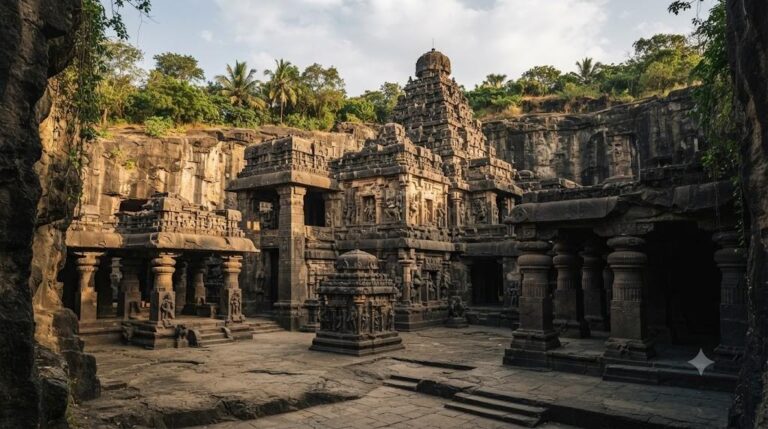
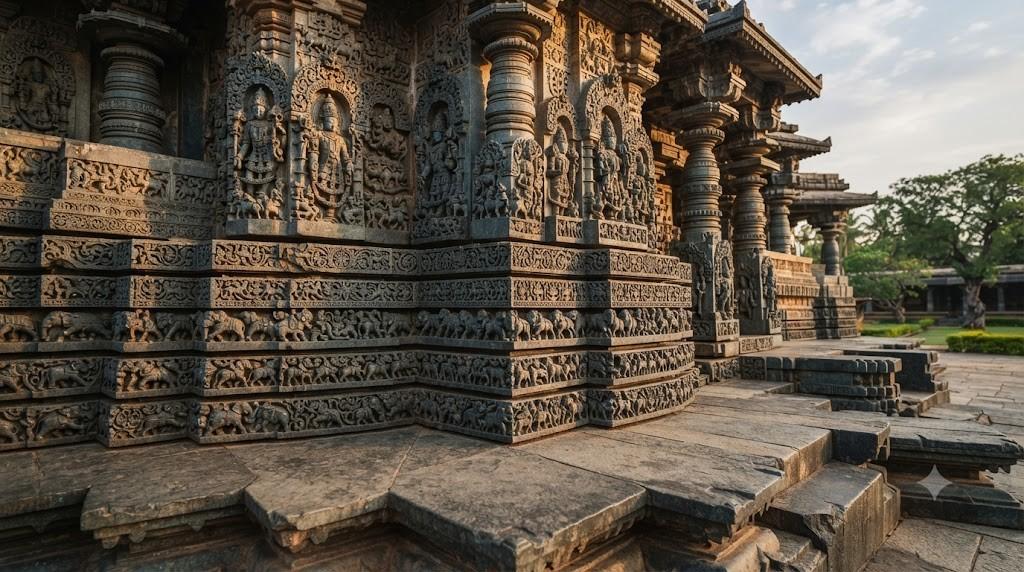
Flourishing between the eleventh and fourteenth centuries in the fertile southern plateaus of Karnataka, the Hoysala Empire produced an architectural and sculptural style that has no parallel in world art. Departing from the rigid granite norms of neighboring realms, Hoysala artisans harnessed the malleable qualities of chloritic schist (soapstone) to chisel temples of astonishing geometric complexity, featuring star-shaped platforms, micro-carved bracket figures, and narrative friezes of breathtaking filigree precision.
The rise of the Hoysala Empire represents one of South India’s most extraordinary cultural flowerings. Originally emerging as hill chieftains in the densely forested Western Ghats of Malnad, the Hoysalas gradually asserted independence from their Western Chalukyan overlords, establishing a dominant sovereign empire that ruled modern-day southern Karnataka, parts of western Andhra Pradesh, and northern Tamil Nadu. Under visionary monarchs like King Vishnuvardhana, Queen Shantala Devi, and King Veera Ballala II, the Hoysala court transformed royal wealth into enduring monuments of spiritual devotion and sculptural brilliance.
The Origin Myth and Imperial Ascendance of the Hoysalas
The founding legend of the Hoysala dynasty is immortalized in stone at the entrance of nearly every major Hoysala temple. According to enduring folklore, a young prince named Sala was studying in a forest hermitage near Sasakapura (modern Angadi in Chikmagalur) under the tutelage of a Jain preceptor named Sudatta. Suddenly, a ferocious royal tiger sprang from the jungle toward the sage. Handing his disciple a slender iron blade, the preceptor shouted: ‘Hoy, Sala!’ (Strike, Sala!). The brave youth lunged forward and slew the beast with a single blow.
This dramatic act of valor gave the dynasty its royal name—Hoysala—and became the imperial royal crest. In temples at Belur, Halebidu, and Somanathapura, freestanding stone sculptures depict Sala poised in dynamic martial posture, driving his dagger into the jaw of a rearing mythical feline. Moving beyond myth, historical epigraphs indicate that the early Hoysalas were skilled mountain warriors who capitalized on the decline of the Western Chalukyas and Cholas to forge an autonomous, prosperous state with its capital at Dorasamudra (modern Halebidu).
The King Vishnuvardhana and the Jain-Vaishnava Transition
The definitive architect of Hoysala imperial greatness was King Bittideva, who reigned from 1108 to 1152 CE. Early in his reign, Bittideva was an adherent of Jainism. However, under the profound philosophical influence of the great Sri Vaishnava theologian and reformer Sri Ramanujacharya—who sought asylum in Karnataka from Shaivite persecution in the Chola realm—the king formally converted to Vaishnavism, adopting the regal coronation name Vishnuvardhana.
Far from suppressing other faiths, Vishnuvardhana practiced remarkable religious ecumenism. His senior queen, Shantala Devi, remained a devout follower of Jainism, renowned as an accomplished patron of the arts, classical Sanskrit dancer, and patroness of Jain basadis. To celebrate his military emancipation from Chola hegemony following the historic Battle of Talakadu in 1116 CE, Vishnuvardhana commissioned the construction of five magnificent Vaishnavite shrines—the celebrated Pancha Narayana temples—the most radiant of which is the Chennakeshava Temple at Belur.
| Pancha Narayana Temple | Geographic Location | Presiding Deity | Year of Consecration | Historical Context |
|---|---|---|---|---|
| Chennakeshava Temple | Belur, Hassan | Lord Vijayanarayana (Keshava) | 1117 CE | Commemorates military triumph over Cholas at Talakadu |
| Kirti Narayana Temple | Talakadu, Mysore | Lord Kirti Narayana | 1117 CE | Built directly upon the conquered Chola provincial capital |
| Veera Narayana Temple | Gadag, Gadag | Lord Veera Narayana | c. 1117 CE | Celebrates northern territorial expansion into Chalukyan borders |
| Nambinarayana Temple | Tondanur, Mandya | Lord Nambinarayana | c. 1115 CE | Established near Ramanujacharya’s temporary retreat refuge |
| Cheluva Narayana Temple | Melukote, Mandya | Lord Cheluvanarayana Swamy | 12th Century | Vibrant pilgrimage center expanded under royal patronage |
Architectural Revolution: Soapstone and Stellate Geometry
Hoysala architecture represents a radical, brilliant evolutionary divergence from the traditional Dravidian temple typologies of Tamil Nadu and the Nagara temples of North India. Hoysala master builders introduced three revolutionary architectural and structural innovations:
The Medium: Chloritic Schist (Soapstone)
While their predecessors chiseled intractable granite or coarse sandstone, Hoysala architects sourced local deposits of chloritic schist, commonly referred to as soapstone. When freshly quarried from subterranean depths, soapstone is remarkably soft, pliant, and yielding to the chisel. This unique material property allowed sculptors to execute microscopic, filigree-like undercuts, hollow jewelry, and intricate textural patterns with jeweler-like precision.
Upon prolonged exposure to atmospheric air and sunlight over several decades, chemical oxidation occurs within the stone’s mineral matrix, causing it to harden into dense, weather-resistant rock. This remarkable material transition preserved Hoysala relief sculptures across nine centuries of exposure to monsoon rains and tropical sun.
The Stellate Ground Plan and the Elevated Jagati
Traditional Indian temples typically feature square or rectangular sanctums. Hoysala master architects introduced a revolutionary geometric innovation: the Stellate (Star-Shaped) Plan. By rotating a square around a central fixed axis at precise angular intervals (typically 4.5, 9, or 22.5 degrees), they generated complex 16-point, 24-point, or 32-point star-shaped sanctum footprints.
This geometric rotation yielded two profound structural and artistic advantages:
- Multiplication of Sculptural Surface Area: A star-shaped exterior wall has a perimeter nearly twice as long as a standard square wall of equivalent internal volume. This provided Hoysala master sculptors with an expansive horizontal canvas to carve hundreds of linear meters of narrative friezes without expanding the temple’s internal footprint.
- Dramatic Light and Shadow Interplay: As the sun traverses the sky, the projecting and receding angular facets of the star-shaped walls cast deep, shifting shadows. This dynamic chiaroscuro effect lends the stone sculptures an astonishing sense of movement, depth, and three-dimensional vibrancy.
- The Elevated Jagati Platform: Hoysala temples omit the soaring entry gopurams of southern Dravidian temples. Instead, the entire temple complex is elevated upon a broad, star-shaped stone platform called a Jagati. Rising one to two meters above ground level, the Jagati serves as an open-air circumambulatory pathway (pradakshina patha), allowing devotees to walk around the exterior walls at eye level with the narrative friezes before entering the dim, atmospheric sanctum.
📐 Architectural Insight: The Base Frieze Hierarchy
The lower plinth of a Hoysala temple is invariably structured in a strict symbolic hierarchy of horizontal bands. The lowest band depicts marching Elephants (symbolizing stability and military strength); the second band features Lions (valor and courage); the third shows floral foliage (natural beauty); the fourth depicts galloping Cavalry Horses (speed and martial prowess); the fifth presents mythological Makaras (water monsters symbolizing aquatic fertility); and the sixth illustrates Hamsas (celestial swans symbolizing spiritual discernment).
The Jewel of Belur: The Chennakeshava Complex
Standing in the heart of Hassan district, the Chennakeshava Temple at Belur represents the crown jewel of early Hoysala art. Commissioned by King Vishnuvardhana in 1117 CE, the temple required one hundred and three years of continuous labor by three generations of master craftsmen to reach completion.
The interior of the temple is an architectural marvel of polished stone engineering. The central congregational hall (Navaranga) is supported by forty-eight intricately lathe-turned monolithic pillars. Utilizing a mechanical horizontal lathe mechanism powered by waterwheels or draft animals, artisans rotated massive soapstone cylinders while applying sharp iron chisels, producing perfectly symmetrical circular moldings, fluted rings, and mirror-smooth surfaces that gleam like black marble.
The Madanikas of Belur: Celestial Poetry in Stone
Suspended high on the exterior pillars beneath the sloping eaves of the Belur temple are thirty-eight world-renowned bracket figures known as Madanikas (or Salabhanjikas). Carved in breathtaking three-dimensional undercut relief from single blocks of soapstone, these sculptures portray idealized celestial maidens engaged in music, dance, athletics, and self-adornment:
- Darpana Sundari (The Maiden with the Mirror): The most famous sculpture in the complex. A graceful woman gazes with subtle self-satisfaction into an oval stone mirror held in her delicate left hand, while her right hand adjusts an ornate earring. The undercut carving is so delicate that her stone bangles can be gently rotated around her wrists.
- The Archer Maiden (The Huntress): Depicts an athletic huntress drawing a stone bowstring, her gaze locked on distant quarry, muscles taut with tension, wearing miniature woven leaf sandals chiseled onto her feet.
- The Drummer (Mridanga Vadini): A dancer caught mid-movement, her fingers frozen in the act of striking a two-headed drum, her heavy braided hair flying outward with realistic centrifugal momentum.
- The Flautist and the Maiden with the Scorpion: Other bracket panels portray a maiden shaking a venomous scorpion from her slipping silk garments with comic alarm, and a celestial musician playing a flute whose hollow bore-holes were delicately drilled through solid stone.
The Grandeur of Halebidu: Hoysaleshwara’s Stone Epics
Located sixteen kilometers east of Belur in the ancient capital of Dorasamudra, the Hoysaleshwara Temple at Halebidu is a twin-shrined (dvikuta) Shaivite temple of monumental scale. Dedicated to Hoysaleshwara and Shantaleshwara, the temple represents the structural climax of middle Hoysala architecture, completed around 1160 CE by chief architect Kedaroja under King Narasimha I.
While the temple’s twin superstructure towers were destroyed during fourteenth-century invasions, the surviving stone walls present an unbroken panoramic relief frieze over two hundred meters long. Over two hundred and forty massive relief panels depict scenes from the Ramayana, Mahabharata, and Bhagavata Purana with cinematic narrative vigor. In one celebrated panel, the demon king Ravana attempts to shake Mount Kailasa with his twenty muscular arms, while terrified forest animals clamber up rock crevices and Shiva calmly presses his toe down to trap the demon’s hands beneath the mountain.
| Hoysala Masterwork | Location | Shrine Typology | Dedicated Deities | Key Sculptural Highlights |
|---|---|---|---|---|
| Chennakeshava Temple | Belur, Hassan | Ekakuta (Single shrine) | Lord Keshava (Vishnu) | 38 exterior Madanikas, lathe-turned pillars, Mohini pillar |
| Hoysaleshwara Temple | Halebidu, Hassan | Dvikuta (Twin shrines) | Hoysaleshwara & Shantaleshwara | 200-meter narrative frieze, monolithic Nandi pavilions, Ravana Kailasa |
| Keshava Temple | Somanathapura, Mysuru | Trikuta (Triple shrines) | Keshava, Janardhana, Venugopala | Perfect stellar symmetry, 3 intact shikharas, signed Mallitamma panels |
| Amruteshwara Temple | Amruthapura, Chikmagalur | Ekakuta (Single shrine) | Lord Shiva as Amruteshwara | Circular lathe-turned mandapa, 140 Mahabharata narrative panels |
| Veera Narayana Temple | Belavadi, Chikmagalur | Trikuta (Triple shrines) | Veera Narayana, Venugopala, Yoga Narasimha | 59 lathe-turned polished pillars, serene Venugopala flautist idol |
The Signed Masters: The Human Faces Behind the Chisels
One of the most remarkable and unique aspects of Hoysala art is the practice of sculptor signatures. In classical Indian art history, master artisans generally remained anonymous, dedicating their creative output entirely to the divine. The Hoysala era decisively broke with this convention.
Proud master sculptors inscribed their personal names, ancestral villages, titles, and even playful professional rivalries at the base of their carved pedestals. Inscriptions preserve the celebrated names of:
- Ruvari Mallitamma: Perhaps the most prolific master sculptor of the thirteenth century, who carved over forty signed relief panels at Somanathapura and worked on temples at Nuggehalli and Haranhalli. His signature reveals a distinctive fluid style characterized by delicate drapery folds and expressive facial contours.
- Dasoja of Balligavi and his son Chavana: The preeminent father-and-son artistic team responsible for four of the finest bracket Madanikas at Belur. Inscriptions proudly describe Dasoja as ‘the thunderbolt to the mountain of rival sculptors’ and Chavana as ‘the master of three worlds of stonecraft’.
- Kedaroja: Chief royal architect to King Narasimha I, who directed the master plan of the Hoysaleshwara complex at Halebidu.
🧭 Visitor Guide: Exploring the Hoysala Triangle
A thorough exploration of the Hoysala heartland is best anchored from Hassan city, situated midway between Bengaluru and Mangaluru. Hassan offers quality hotels and allows day excursions to Belur (35 km), Halebidu (30 km), Belavadi (45 km), and the historic Jain colossus at Shravanabelagola (50 km).
In September 2023, the global significance of this artistic heritage received ultimate international validation when UNESCO officially inscribed the Sacred Ensembles of the Hoysalas—uniting Belur, Halebidu, and Somanathapura—onto the World Heritage List. Today, as visitors run their fingers along the smooth, cool surfaces of lathe-turned pillars and marvel at the microscopic lace-like stone ornaments carved nine centuries ago, they witness a golden age where devotion, geometry, and human artistic ambition reached perfection.
The Sacred Geometry of Mandapas: Lathe-Turned Pillars and Ceiling Domes
While the exterior walls of Hoysala temples captivate visitors with their narrative friezes, the interior architecture of the congregational halls (Navaranga and Mukhamandapa) represents an extraordinary triumph of stone turning and interlocking ceiling engineering. The central bays of these halls are invariably crowned by deeply recessed, multi-tiered domical ceilings that create an illusion of cosmic ascension.
These ceiling domes were constructed without mortar, utilizing concentric circular rings of dressed soapstone slabs that cantilever inward toward a central hanging stone pendant shaped like an unfurling lotus bud (padma). The master sculptors chiseled intricate relief friezes into these ceiling rings, portraying the eight celestial directional guardians (Ashtadikpalas) mounted on their divine vehicles, surrounded by swirling floral arabesques and dancing apsaras. The sheer mathematical precision required to ensure that thousands of kilograms of cantilevered stone remained structurally stable over nine centuries remains a subject of awe among modern structural engineers.
🔨 Artistic Rivalry: The Guilds of Balligavi and Belur
Hoysala sculptor inscriptions document intense, good-natured artistic rivalries between competing artisan guilds. Sculptor Mallitamma proudly carved his monograms into miniature drapery folds, while master Dasoja challenged any contemporary craftsman to duplicate the hollow-carved stone chains and rotating bangles of his Belur Madanikas.