👑 Royal Grandeur: The Jewel of the Deccan
Rising majestically in the heart of Mysuru, the Amba Vilas Palace (popularly known as the Mysore Palace) stands as one of the most visited, architecturally splendid, and historically layered royal residences on the planet. Designed by celebrated British architect Henry Irwin and commissioned by the visionary Maharani Kempananjammanni in 1897 following the destruction of the old wooden palace by fire, the edifice represents the crowning triumph of the Indo-Saracenic architectural style, harmonizing Hindu, Mughal, Rajput, and Gothic design elements into an unforgettable royal citadel.
The city of Mysuru (anciently Mahishuru, associated with the mythological demon Mahishasura slain by Goddess Chamundeshwari) has functioned as the royal capital of the Wodeyar Dynasty for over six centuries. Established in 1399 CE by founders Yaduraya and Krishnaraya, the Wodeyars ruled the Kingdom of Mysore with remarkable administrative foresight, progressive social reforms, and generous patronage of classical Carnatic music, Sanskrit scholarship, and fine arts. At the physical and ceremonial epicenter of this princely realm sits the Amba Vilas Palace, an architectural masterpiece that attracts over six million visitors annually, standing second only to the Taj Mahal in international tourism acclaim.
The Phoenix of Mysuru: The Fire of 1897 and Henry Irwin’s Vision
The historic royal palace of Mysore was traditionally constructed of seasoned rosewood, teak, and carved timber masonry. In February 1897, during the lavish wedding celebrations of Princess Jayalakshammanni (eldest daughter of Maharaja Chamaraja Wodeyar IX), a catastrophic fire broke out within the wooden palace pavilion. Fueled by centuries-old varnished timber, the inferno consumed the ancient structure within hours, leaving behind a smoking ruin of charred stone foundations.
Undeterred by this tragedy, the young Maharaja Krishnaraja Wodeyar IV’s regent mother, Maharani Kempananjammanni Vani Vilasa Sannidhana, resolved to construct a modern, fireproof imperial palace that would symbolize the resilience, sophistication, and modernity of the Kingdom of Mysore. The royal court commissioned the preeminent British consulting architect of British India, Lord Henry Irwin (celebrated for his design of the Madras High Court and the Victoria Memorial Hall in Chennai), to draft an ambitious architectural master plan.
Indo-Saracenic Synthesis: A Harmony of Four Civilizations
Henry Irwin’s design for the new Amba Vilas Palace—constructed between 1897 and 1912 at a colossal cost of over four million rupees—became the definitive textbook example of the Indo-Saracenic architectural style. The three-storied palace structure, built of fine grey granite ashlar masonry and crowned by deep-pink marble onion domes, harmoniously fuses four great architectural idioms:
- Hindu Dravidian & Hoysala Elements: The palace exterior features carved soapstone friezes, projecting stone eaves (chhajjas), and an imposing central square tower rising forty-four meters (one hundred and forty-five feet) into the sky, crowned by a gilded five-story dome reminiscent of temple gopurams.
- Islamic / Mughal Geometry: Symmetrical cusped arches, fluted onion domes, vaulted marble cupolas, and open courtyards that capture natural light and ventilation.
- Rajput Courtly Features: Ornate jharokha balcony windows, decorative stone brackets, and pierced lattice screens (jalis) that frame private viewing chambers.
- European Gothic & Neo-Classical Engineering: High-tensile iron girders, cast-iron support columns manufactured by Walter Macfarlane’s Saracen Foundry in Glasgow, imported Scottish stained glass skylights, and Italian glazed ceramic tiles.
| Palace Wing / Chamber | Structural Material | Architectural Style | Primary Ceremonial Function | Signature Visual Highlight |
|---|---|---|---|---|
| Kalyana Mandapa (Marriage Pavilion) | Iron, Glass, Glazed Tiles | Octagonal Gothic Pavilion | Royal royal weddings & public gatherings | Peacock stained glass domed ceiling from Glasgow |
| Diwan-i-Khas (Private Durbar) | Cast Iron, Teak, Gilt Plaster | Indo-Saracenic Arcade | Executive cabinet meetings with royal ministers | Turquoise and gold cusped arches, stained glass |
| Diwan-i-Aam (Public Durbar) | Grey Granite & Marble | Expansive Multi-Pillared Hall | Public audiences during Vijayadashami | Sweeping vistas overlooking Chamundi Hill and parade ground |
| Gombe Thotti (Doll’s Pavilion) | Granite, Teakwood, Ivory | Traditional Heritage Gallery | Exhibition of royal ceremonial artifacts | Golden Howdah (Ambari), miniature European dolls |
| Central Clock Tower | Granite & Gilded Brass | Gothic-Dravidian Campanile | Timekeeping and royal architectural anchor | 44-meter tower housing brass bell and five-face clock |
The Ceremonial Chambers: Kalyana Mandapa and the Durbar Halls
Stepping inside the interior ceremonial wings of the Mysore Palace reveals an overwhelming sensory feast of colored glass, gilded plasterwork, polished rosewood, and precious stone inlays.
The Kalyana Mandapa (The Royal Marriage Pavilion)
The Kalyana Mandapa is an octagonal, grand pavilion soaring three stories high, designed to host royal weddings, state banquets, and sacred coronation rituals. The defining architectural glory of this hall is its magnificent vaulted stained glass ceiling, manufactured in Glasgow, Scotland, featuring hundreds of vibrantly colored glass panes arranged in intricate floral and geometric motifs.
At the apex of the dome, the glass panes depict swirling peacock feathers in brilliant emerald, turquoise, and cobalt blue hues. The mosaic tile floor beneath the dome was imported from Stoke-on-Trent in England, arranged in geometric mandalas that reflect the filtered sunlight cascading from the dome above. Around the walls of the pavilion hang twenty-six colossal oil paintings by celebrated court painters, depicting the grand Mysore Dasara processions of the early twentieth century with photographic realism, capturing portraits of real royal courtiers, British resident diplomats, and imperial guards.
The Diwan-i-Khas: The Jewel of Private Audiences
The Diwan-i-Khas (Private Durbar Hall) is an opulent, colonnaded gallery where the Maharaja received foreign ambassadors, executive state ministers (Dewans), and honored guests. The hall is defined by rows of massive cast-iron columns painted in rich turquoise blue, supporting exquisitely detailed cusped arches gilded with pure gold leaf.
The ceiling is adorned with relief plaster medallions portraying the signs of the zodiac, while the central floor is covered with cool Italian marble inlays. Intricate Belgian crystal chandeliers illuminate the hall, while teakwood doors inlaid with ivory, rosewood, and mother-of-pearl depict floral arabesques and avatars of Vishnu, showcasing the virtuoso skill of Mysore’s hereditary master carpenters.
🎨 Artistic Legend: Raja Ravi Varma’s Masterpieces
The palace preserves an extraordinary private art gallery containing original oil paintings by celebrated Indian royal artist Raja Ravi Varma. Commissioned by Maharaja Chamaraja Wodeyar, these masterworks—including ‘Ravana Slaying Jatayu’, ‘Harischandra’, and portraits of the royal family—pioneered the modern visual representation of Indian mythological literature.
The Golden Throne (Chinnada Simhasana) and the Golden Howdah
The spiritual and sovereign essence of the Mysore royal family is enshrined in two legendary artifacts that are displayed to the public exclusively during the annual autumn Dasara festivities:
The Golden Throne (Chinnada Simhasana)
Steeped in ancient mythological lore, the Golden Throne of Mysore is believed according to tradition to have belonged originally to the Pandavas of the Mahabharata, passing through centuries of dynastic hands before being presented to the Vijayanagara rulers and subsequently acquired by Raja Wodeyar I in 1610 CE at Srirangapatna.
Crafted of heavy fig wood (Udumbara) and overlaid with over two hundred and eighty kilograms of pure, engraved solid gold plates, the throne is a masterpiece of sacred goldsmithing. The steps ascending to the throne are guarded by four golden lions, while the seat is crowned by a golden umbrella (Chhatra) bearing a mythical double-headed celestial bird known as the Gandaberunda—the ancient royal emblem of the Kingdom of Mysore, adorned with dangling pearls and precious emeralds. The throne is assembled in the Diwan-i-Aam only during Dasara, following strict Vedic astrological consecrations.
The Golden Howdah (Chinnada Ambari)
Equally famous is the Golden Howdah (Ambari), a ceremonial carriage weighing seven hundred and fifty kilograms, crafted from solid gold plates mounted on a wooden frame. On the tenth and final day of Dasara (Vijayadashami), the golden howdah—carrying the sacred idol of Goddess Chamundeshwari—is mounted atop the back of a majestic royal tusker elephant, leading a five-kilometer grand victory procession (Jumboo Savari) through the streets of Mysuru before hundreds of thousands of cheering citizens.
🦅 Numismatic & Heraldic Legacy: The Gandaberunda
The two-headed mythological bird, the Gandaberunda, represents the supreme emblem of sovereign power and cosmic balance in Karnataka. Originally adopted by the Chalukyas and Vijayanagara emperors, it was immortalized by the Wodeyars on palace gates, royal flags, and gold coins, and continues today as the official state emblem of the Government of Karnataka.
The Spectacle of Mysore Dasara: The City of Lights
While the palace is mesmerizing by day, it reaches an otherworldly, fairy-tale splendor during the annual ten-day festival of Mysore Dasara (celebrated in September or October). Commenced in 1610 CE by Raja Wodeyar I, the state festival commemorates the triumph of Goddess Chamundeshwari over the buffalo demon Mahishasura.
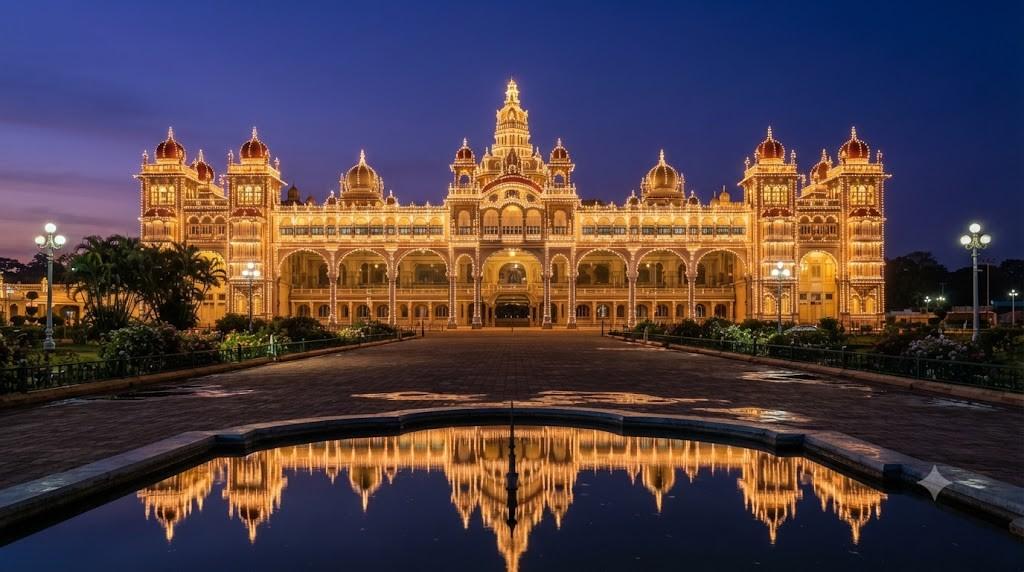
Every evening during the festival, the entire exterior of the Mysore Palace is illuminated by nearly one hundred thousand incandescent light bulbs. As darkness falls over the city, the switch is thrown, and in a single dramatic instant, the entire granite palace bursts into a glowing golden silhouette against the night sky, reflected in the surrounding fountains like an enchanted celestial palace. Tens of thousands of spectators gather on the royal parade grounds to witness this breathtaking spectacle of illumination, accompanied by royal police brass band concerts and classical Carnatic violin performances.
| Festival Element | Ceremonial Timeline | Primary Participants | Cultural / Spiritual Meaning |
|---|---|---|---|
| Khasa Durbar (Private Durbar) | Days 1 to 9 of Dasara | Maharaja seated on the Golden Throne | Continuation of 400-year royal court ritual |
| Ayudha Puja (Worship of Tools) | Day 9 (Mahanavami) | Royal family, palace staff, state artisans | Sacred consecration of royal weapons, vehicles, and tools |
| Jumboo Savari (Elephant Parade) | Day 10 (Vijayadashami) | Lead tusker carrying 750 kg Golden Howdah | Grand civic procession celebrating victory of good over evil |
| Torchlight Parade (Bannimantap) | Evening of Vijayadashami | Mounted royal cavalry, police bands, laser shows | Martial salute and imperial military drill |
| Palace Illumination (97,000 bulbs) | Every evening during Dasara (7–9 PM) | Open to general public on palace lawns | Iconic visual symbol of Mysuru’s cultural festival |
The Legacy of the Wodeyars: Progressive Modernity and Patronage
The enduring glory of the Mysore Palace is inseparable from the progressive governance of its builders. Under Maharaja Krishnaraja Wodeyar IV (reigned 1902–1940 CE)—whom Mahatma Gandhi famously called the ‘Rajarshi’ (Philosopher King)—the Kingdom of Mysore became recognized as the most progressive, industrialized, and enlightened princely state in British India.
Working alongside visionary Dewans such as Sir M. Visvesvaraya and Sir Mirza Ismail, the Wodeyars established the University of Mysore, built the landmark Krishna Raja Sagara (KRS) Dam and Brindavan Gardens, commissioned Asia’s first hydroelectric power plant at Shivanasamudra, established the Indian Institute of Science (IISc) in Bengaluru with Jamsetji Tata, and introduced free primary education for girls and democratic representative assemblies decades before Indian independence.
Practical Visitor Information, Photography, and Etiquette
Exploring the Mysore Palace is an essential pilgrimage for any traveler visiting South India. To make the most of your visit, keep the following practical guidelines in mind:
- Opening Hours and Illumination: The palace is open daily from 10:00 AM to 5:30 PM. The exterior illumination takes place on Sundays and public holidays from 7:00 PM to 7:45 PM, and every evening throughout the ten days of Dasara.
- Footwear and Security Protocols: Visitors must remove their footwear at designated safe deposit counters before entering the palace interior, as walking on the delicate historic mosaic tile floors requires bare feet or socks. Professional camera gear requires a nominal permit, while flash photography inside private portrait galleries is restricted.
- Audio Guides and Guided Tours: Multilingual audio guides in English, Kannada, French, German, and Spanish are available at the entrance, providing rich historical context for every room, ceiling fresco, and royal portrait.
In conclusion, the Amba Vilas Palace of Mysuru is far more than an opulent residence of kings; it is an enduring monument to human resilience, artistic synthesis, and enlightened civilizational leadership. Standing beneath its glowing pink domes as the evening breeze carries the sound of the palace chimes, one realizes that the golden spirit of the Wodeyars still lives—a radiant beacon of South India’s royal dignity, artistic brilliance, and cultural soul.
The Royal Armoury and Antique Weapon Metallurgy
A fascinating, frequently overlooked section of the Mysore Palace is the Royal Armoury (Ayudhashala), which preserves over seven hundred historic weapons dating from the fourteenth to the early twentieth centuries. The collection documents the evolution of South Indian martial technology from traditional edged weapons to early European flintlocks and Damascus steel blades.
Among the prized exhibits are personal swords wielded by celebrated historical figures including Maharaja Kanteerava Narasaraja Wodeyar, Hyder Ali, and Tipu Sultan. Visitors can inspect ceremonial double-edged swords (Khandas) with gold-inlaid hilts, tiger-claw daggers (Bagh Nakh) concealed within rings, gem-encrusted punch daggers (Katars) engineered with scissor-like expanding blades, and specialized matchlocks decorated with floral ivory inlays. The collection demonstrates the extraordinary metallurgical expertise of Karnataka’s historical armorers, who mastered high-carbon crucible wootz steel centuries before modern industrial metallurgy.
🪵 Heritage Craft: Mysore Rosewood Inlay
The palace interior serves as a living museum of Mysore Rosewood Inlay, an internationally renowned GI-certified craft. Master artisans carve delicate recesses into dark seasoned rosewood, embedding hand-cut pieces of ivory, mother-of-pearl, and naturally tinted wood veneers to create intricate pictorial panels depicting courtly scenes and forest wildlife.