🌊 The Sacred Shorelines of Parashurama Kshetra
Stretching three hundred kilometers along the azure expanse of the Arabian Sea, the coastline of Karnataka represents one of India’s most spiritually venerated pilgrimage corridors. Known anciently as Parashurama Srishti—the land reclaimed from the ocean by the mythological sage Parashurama—Karavali combines monumental modern engineering marvels such as Murudeshwar’s colossal sea-cliff Shiva statue with ancient Vedic sanctuaries like Gokarna’s Atmalinga shrine, coastal river deltas, and dramatic marine headlands.
Coastal Karnataka (Karavali) occupies a uniquely sacred position in the spiritual geography of South Asia. Bounded on the east by the sheer emerald walls of the Western Ghats and on the west by the pounding waves of the Arabian Sea, this coastal corridor has witnessed over two millennia of maritime trade, Vedic philosophical scholarship, and devotional architectural experimentation. From the ancient Shaivite pilgrimage sanctuaries of Gokarna to the monumental modern sea-cliff temples of Murudeshwar and the serene estuarine shrines of Maravanthe and Udupi, exploring Coastal Karnataka’s sacred circuit offers an unforgettable journey through devotion, folklore, and coastal majesty.
The Legend of the Atmalinga: The Sacred Origin of Coastal Shrines
To understand the spiritual interconnection uniting Coastal Karnataka’s temples, one must examine the ancient Puranic legend of the Atmalinga—the divine embodiment of Lord Shiva’s supreme cosmic energy. According to the Shiva Purana, the powerful demon king Ravana performed intense, rigorous penances on Mount Kailasa to please Lord Shiva.
Pleased by his unyielding devotion, Lord Shiva granted Ravana his supreme boon: the sacred Atmalinga, which had the power to make whoever possessed it completely invincible. However, Shiva imposed one strict, non-negotiable condition: ‘Wherever you place the Atmalinga upon the earth, it will permanently take root, and no force will ever be able to move it again.’
Ganesha’s Divine Deception and the Scatter of Sacred Relics
Fearing that the demon king would become invincible and conquer the three worlds, the gods appealed to Lord Ganesha for assistance. As Ravana flew southward carrying the divine lingam along the western coast of Karnataka, the sun was about to set, and the demon king was obligated to perform his mandatory evening ritual prayers (Sandhyavandanam).
Unable to place the lingam on the ground, Ravana spotted a young cowherd boy—who was Lord Ganesha in disguise. Ravana requested the boy to hold the heavy lingam while he bathed in the sea, instructing him never to set it down. Ganesha agreed on the condition that he would call Ravana’s name three times, and if Ravana did not return, he would place it on the earth. As soon as Ravana stepped into the ocean waves, Ganesha called his name three times in rapid succession, set the Atmalinga firmly upon the ground at Gokarna, and vanished.
Returning from the sea, Ravana was enraged to find the lingam permanently rooted to the earth. In a desperate fury, he exerted all his colossal strength to rip the lingam out of the ground, twisting and pulling with twenty muscular arms. The force fractured the divine relic and scattered its covering materials across the coastline:
- The Atmalinga Core (Gokarna): The central core remained rooted at Gokarna, compressed into the shape of a cow’s ear (Gokarna), where the ancient Mahabaleshwar Temple stands today.
- The Casket Covering (Sajjeshwara): The stone covering casket was thrown thirty kilometers away, forming the sacred shrine of Sajjeshwara near Karwar.
- The Casket Lid (Dhareshwara): The lid of the casket landed further south near Kumta, consecrated as the Dhareshwara Temple.
- The Cloth Wrapping (Gunavantheswara): The sacred cloth wrapping the lingam landed at Gunavanthe near Honnavar.
- The Binding Cord (Murudeshwar): The sacred cord (pattabandha) tying the lingam was flung thirty-five kilometers southward, landing on the sea-cliff promontory of Kanduka Hill, where the world-famous Murudeshwar Temple stands today.
| Sacred Coastal Shrine | Atmalinga Relic Association | Presiding Deity | Geographic Setting | Primary Ritual / Architectural Landmark |
|---|---|---|---|---|
| Gokarna Mahabaleshwar | The Core Rooted Atmalinga | Lord Mahabaleshwar (Shiva) | Ancient coastal town beside Kotiteertha | Atmalinga viewing pit, Kotiteertha holy tank |
| Murudeshwar Temple | The Binding Cord (Pattabandha) | Lord Murudeshwara (Shiva) | Sea-cliff promontory (Kanduka Hill) | 123-foot colossal Shiva statue, 20-story Raja Gopuram |
| Dhareshwara Temple | The Casket Lid | Lord Dhareshwara (Shiva) | National Highway 66 coastal grove | Ancient Chalukyan-style stone temple with tank |
| Gunavantheswara Temple | The Sacred Cloth Wrapping | Lord Gunavantheswara (Shiva) | Near Sharavathi river estuary | Serene rural pilgrimage shrine with lotus pond |
| Maravanthe Varahaswamy | Ancient Coastal Shoreline Shrine | Varaha (Boar Incarnation) | Narrow landspit between sea & river | Unique temple nestled between ocean and Souparnika river |
Murudeshwar: Colossal Modern Monumentalism on Kanduka Hill
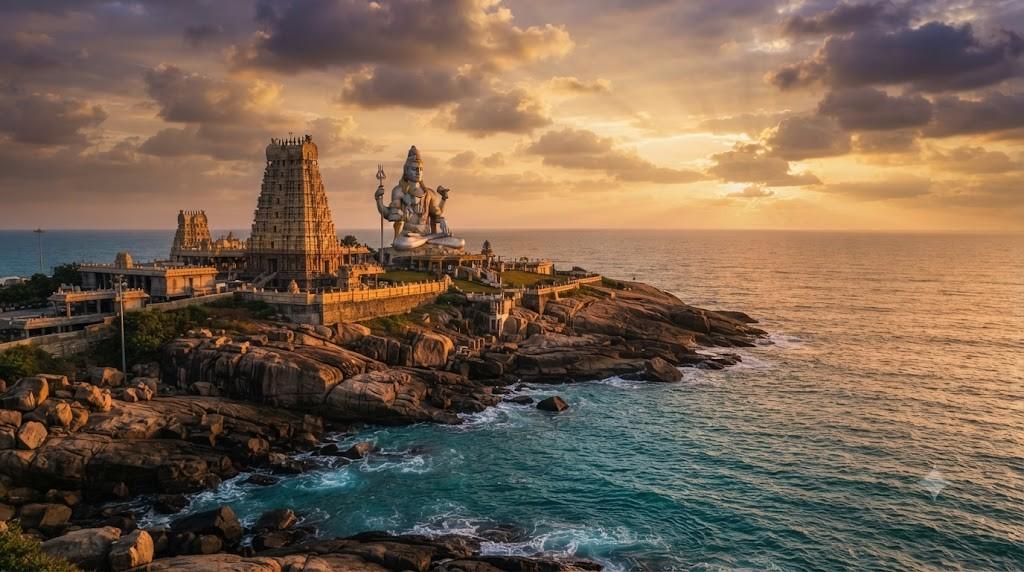
Situated in Uttara Kannada district, Murudeshwar presents an astonishing, breathtaking juxtaposition of ancient Puranic antiquity and modern monumental engineering. The temple complex is perched atop the dramatic promontory of Kanduka Hill, a high rocky headland surrounded on three sides by the crashing waves of the Arabian Sea.
In the late twentieth century, visionary philanthropist and industrialist R.N. Shetty sponsored a colossal transformation of the pilgrimage site, commissioning renowned master sculptors and civil engineers to create a modern architectural marvel that has become one of India’s most recognized coastal landmarks.
The 123-Foot Colossal Shiva Statue
Rising majestically against the open horizon, the colossal seated statue of Lord Shiva at Murudeshwar stands one hundred and twenty-three feet (thirty-seven meters) high, making it the second-tallest statue of Lord Shiva on the planet. Designed by master sculptor Kashinath of Shimoga, the statue took over two years to construct from reinforced cement concrete, covered in shimmering bronze and gold paint that reflects the morning sea spray.
Shiva is depicted seated in serene meditation in the Padmasana posture, his four arms holding the trident (Trishula) and sacred drum (Damru), while holy Ganga flows from his matted locks. Beneath the massive statue, an underground cave museum utilizes life-sized animatronic dioramas to narrate the dramatic Puranic tale of Ravana, Ganesha, and the Atmalinga.
The Twenty-Story Raja Gopuram and High-Speed Elevator
Guarding the entrance to the Kanduka Hill promontory is the monumental Raja Gopuram, which soars two hundred and thirty-seven feet (seventy-two meters) into the sky across twenty intricately sculpted pyramidal tiers. It ranks among the tallest temple entrance gopurams in the world.
Remarkably, the interior of the gopuram is equipped with a high-speed passenger elevator. Visitors can ascend to the eighteenth floor, where large viewing windows offer astonishing bird’s-eye panoramas: looking down upon the colossal Shiva statue, the blue waters of the Arabian Sea crashing against the rocks, fishing skiffs bobbing in the coastal harbor, and the distant verdant ridges of the Western Ghats meeting the ocean.
🤿 Adventure Detour: Netrani Island Scuba Diving
Located ten nautical miles off the coast of Murudeshwar lies Netrani Island (Pigeon Island), Karnataka’s premier scuba diving and marine adventure hub. The crystal-clear waters surrounding this uninhabited coral island harbor sea turtles, butterflyfish, moray eels, barracudas, and stingrays.
Gokarna: The Kashi of the South and Beach Headlands
Situated sixty kilometers north of Murudeshwar, the sacred town of Gokarna offers a completely different, deeply introspective spiritual atmosphere. Unlike the modern monumentalism of Murudeshwar, Gokarna has retained its ancient, rustic temple-town character, characterized by narrow paved lanes, traditional tile-roofed Brahmin agraharas, chanting Sanskrit academies, and sacred temple tanks.
The spiritual anchor of the town is the ancient Mahabaleshwar Temple, constructed of dressed granite ashlar masonry in the classical Dravidian style. Within the dark, atmospheric inner sanctum, the venerated Atmalinga is housed beneath a square stone slab with a central opening. Devotees are permitted to reach their hands into the sacred pit to touch the tip of the lingam, which is said to feel like the ear of a cow.
Kotiteertha: The Sacred Bathing Reservoir
Before entering the sanctum, pilgrims perform traditional purification ablutions at Kotiteertha, an expansive rectangular freshwater tank surrounded by stone steps, towering coconut palms, and historic monasteries (Mathas). According to local lore, Sage Agastya created the tank by consecrating waters from one crore (ten million) sacred river sources. Every evening, hundreds of floating oil lamps are set adrift on the dark waters, creating a mesmerizing spiritual spectacle.
Maravanthe: Where the River and Sea Embrace
Traveling south along National Highway 66 between Kundapura and Bhatkal brings voyagers to one of the most picturesque coastal geographic formations in South Asia: Maravanthe Beach. For a breathtaking two-kilometer stretch, the national highway runs along a razor-thin spit of land bounded by two distinct aquatic worlds:
On the right side of the road, the roaring, tempestuous blue waves of the Arabian Sea crash against golden sand beaches; on the immediate left side, just a few meters away, the serene, emerald-green waters of the Souparnika River glide placidly along the base of the Western Ghats. In the center of this narrow spit sits the ancient Maravanthe Varahaswamy Temple, dedicated to the boar incarnation of Vishnu, worshipped by coastal fishermen for safe passage across the dangerous bar where the river finally meets the sea.
| Temple Destination | District | Dress Code Strictness | Opening Hours | Recommended Ritual |
|---|---|---|---|---|
| Gokarna Mahabaleshwar | Uttara Kannada | Strict (Dhoti for men, Sarees for women) | 6:00 AM – 12:30 PM & 5:00 PM – 8:00 PM | Holy dip at Kotiteertha, Sparsha Darshana of Atmalinga |
| Murudeshwar Temple | Uttara Kannada | Moderate traditional attire | 6:00 AM – 1:00 PM & 3:00 PM – 8:15 PM | Raja Gopuram elevator panorama, sunset cliff walk |
| Kollur Mookambika | Udupi | Strict (Men must remove shirts/vests) | 5:00 AM – 1:30 PM & 3:00 PM – 9:00 PM | Vidyarambham initiation, Chandi Homa blessings |
| Udupi Sri Krishna Matha | Udupi | Traditional attire required | 5:30 AM – 9:30 PM (Continuous) | Viewing Krishna through the 9-holed Kanakana Kindi window |
| Anegudde Vinayaka | Udupi / Kumbhashi | Moderate traditional | 6:00 AM – 8:30 PM | Modaka offering to the Mukti-Stala Lord Ganesha |
Pilgrim Etiquette, Coastal Conservation, and Travel Logistics
Navigating the sacred coastal temple circuit of Karnataka requires an appreciation of localized religious customs, temple protocols, and marine environmental responsibility:
- Strict Adherence to Temple Dress Codes: Ancient functional temples such as Gokarna Mahabaleshwar and Kollur Mookambika enforce traditional dress codes. Male devotees must remove all upper garments (shirts, t-shirts, vests) and wear a clean traditional white dhoti, while female devotees should wear modest sarees or traditional salwar kameez. Short skirts, bermudas, and western jeans are strictly barred within inner sanctums.
- Photography Prohibitions: While photography is permitted in the open courtyards of Murudeshwar, taking photos or recording videos inside the inner sanctums of Gokarna, Kollur, and Udupi is strictly illegal. Always respect the sanctity of deep spiritual spaces.
- Preserve Sacred Coastal Waterways: When bathing at sacred coastal sites such as Kotiteertha or Maravanthe, never use chemical soaps, shampoos, or discard plastic flower bags into the water. Support clean-temple initiatives managed by local administration boards.
- Connecting Corridors: The coastal highway NH 66 is well-maintained and connects seamlessly with the Konkan Railway network. Trains like the Matsyagandha Express and Vande Bharat connect Mangaluru with Udupi, Murudeshwar, and Gokarna in comfort, making the entire sacred corridor accessible for multi-day itineraries.
In conclusion, the coastal temples of Karnataka are a profound celebration of human faith anchored within the majestic theater of nature. Standing on the cliff of Murudeshwar as the ocean breeze carries the scent of incense and the sound of temple bells mixes with the eternal roar of the waves, one realizes that here, on the shores of Parashurama Kshetra, the divine and the natural are forever united in timeless harmony.
The Vedic Heritage of Gokarna’s Sanskrit Agraharas
Beyond its famous beaches and the venerated Mahabaleshwar Atmalinga shrine, the town of Gokarna preserves one of the most vibrant and historically unbroken traditions of Vedic Sanskrit scholarship in South Asia. For over a millennium, Gokarna has functioned as an autonomous intellectual capital, housing traditional residential schools (Gurukulas) where young scholars study the Rigveda, Yajurveda, and Samaveda under the guidance of hereditary Vedic acharyas.
The urban fabric of Gokarna is structured around historical Agraharas—tree-shaded residential streets lined with traditional tile-roofed heritage homes featuring broad front verandahs (Jaggali) where scholars gather at dawn and dusk for philosophical debates. Walking through these historic lanes during morning prayer hours, visitors are enveloped by the ancient acoustic resonance of Vedic chanting recited with precise pitch, rhythm, and intonation, preserving an intangible cultural heritage that dates back over three thousand years.
Coastal Culinary Rituals: The Prasada of the Mathas
A pilgrimage through Coastal Karnataka’s sacred circuit is inextricably linked with the sacred culinary traditions of the regional monasteries (Mathas). At Udupi Sri Krishna Matha, Gokarna, and Kollur, thousands of pilgrims are served complimentary sacred meals (Annadaana) every afternoon. Prepared in colossal brass vessels according to ancient Satvik principles without onion or garlic, the meal features piping-hot white rice, fragrant sambar enriched with local ash gourds and drumsticks, spiced rasam, cooling buttermilk, and sweet payasa sweetened with coastal coconut milk and jaggery, demonstrating the profound South Indian ethos of hospitality as the highest form of worship.