🏛️ The Climax of Narrative Stonecraft: Dorasamudra’s Twin Masterpiece
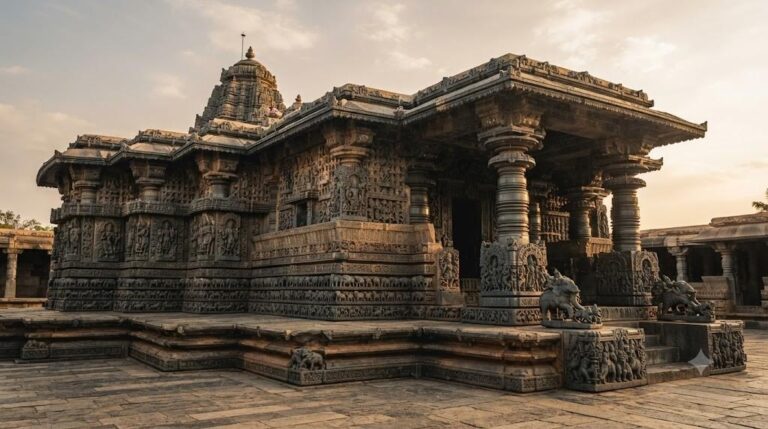
Located sixteen kilometers east of Belur in the ancient Hoysala capital of Dorasamudra, the Hoysaleshwara Temple at Halebidu represents the absolute zenith of narrative stone sculpture in South Asia. Commenced in 1121 CE by Chief Architect Kedaroja under King Vishnuvardhana and expanded across eight decades, this twin-shrined (dvikuta) Shaivite temple presents an unbroken, two-hundred-meter-long panoramic frieze of over two hundred and forty colossal relief panels portraying the entire Hindu pantheon, earning James Fergusson’s praise as an artistic monument that exceeds human imitation.
If the Chennakeshava Temple at Belur is celebrated for its graceful feminine bracket Madanikas, the Hoysaleshwara Temple at Halebidu is revered for its monumental scale, dramatic narrative vigor, and staggering sculptural density. Situated amidst the tranquil agricultural plains of Hassan district, Halebidu (literally ‘The Old Capital’, originally named Dorasamudra) served as the fortified imperial metropolis of the Hoysala Empire for over two centuries. Here, Hoysala stone masons pushed the limits of chloritic schist (soapstone) to create an architectural epic that transforms cold stone into pulsating mythological theater.
Dorasamudra: The Imperial Capital of Lakes and Temples
The city of Dorasamudra was founded in the eleventh century by Hoysala ruler Vinayaditya, who selected the site for its strategic proximity to the massive freshwater reservoir known as Dorasamudra Lake (now Dwarasamudra). The lake provided a reliable perennial water supply for the burgeoning imperial capital, while surrounding hills offered natural defensive barriers against invading armies.
In 1121 CE, wealthy imperial merchant Ketamalla and royal general Boppadeva proposed the construction of a monumental Shaivite temple that would rival King Vishnuvardhana’s newly completed Vaishnavite masterpiece at Belur. King Vishnuvardhana generously granted royal land charters, treasury funds, and master architect Kedaroja to oversee the ambitious project. The temple was conceived as a Dvikuta (twin-shrined) monument dedicated to two lingams: Hoysaleshwara (honoring the royal sovereign) and Shantaleshwara (honoring beloved Queen Shantala Devi).
The Twin-Shrined Stellate Architecture
The architectural footprint of Halebidu is unique among major Indian temples. Instead of a single sanctum, the complex features two complete, identical star-shaped temples built side-by-side along a north-south axis, joined by a spacious central pillared congregational hall. Each shrine possesses its own dedicated sanctum sanctorum (Garbhagriha), vestibule (Sukanasi), and expansive pillared hall (Navaranga).
Furthermore, aligned directly opposite each eastern entrance stand two monumental open pavilions housing colossal monolithic statues of Nandi the Bull, the sacred mount of Lord Shiva. Carved from massive single blocks of dark soapstone and polished to a mirror sheen, these Nandi sculptures measure nearly five meters in length and over two meters in height, adorned with intricately carved floral garlands, bells, and jeweled blankets that appear to be chiseled from soft leather rather than solid rock.
| Architectural Dimension | Hoysaleshwara Metric | Structural Comparison | Artistic Significance |
|---|---|---|---|
| Shrine Typology | Dvikuta (Twin Sanctums) | Hoysaleshwara & Shantaleshwara shrines | Dual spiritual focus honoring king and queen |
| Jagati Platform Length | Approx. 110 meters length | Double-star stellate footprint | Expansive open-air circumambulation deck |
| Exterior Narrative Frieze | Over 200 linear meters | Unbroken continuous horizontal bands | Over 240 colossal high-relief divine panels |
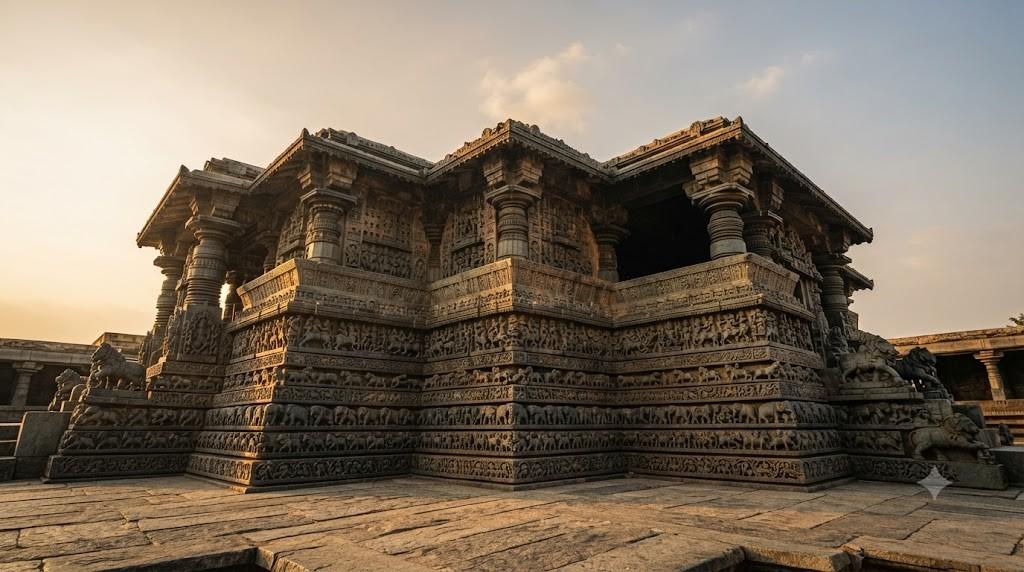
| Base Horizontal Bands | 8 continuous tiers | Elephants, lions, horses, makaras, swans | Hierarchical symbolic foundation of the universe |
| Monolithic Nandi Shrines | Twin detached pavilions | Two colossal 5-meter Nandi monoliths | Rank among India’s largest and most ornate Nandi bulls |
The Exterior Wall Friezes: An Inexhaustible Encyclopedia in Stone
The defining glory of Halebidu—and the feature that attracts world art historians—is the unbroken panoramic bas-relief frieze that wraps around the entire exterior perimeter of the temple. Extending for over two hundred meters, this wall canvas contains over two hundred and forty large-scale relief panels, each standing approximately one meter high, chiseled with astonishing three-dimensional depth.
Nineteenth-century architectural historian James Fergusson, standing before these walls, famously observed that ‘the human hand has never sculpted stone with such astonishing dexterity and inexhaustible variety… If the Parthenon of Athens is the greatest work of classical art, the Hoysaleshwara Temple is certainly the masterpiece of romantic stone architecture.’
The Master Panels of the Hindu Pantheon
Every major deity, avatar, and philosophical concept of medieval Hinduism is depicted on these walls with dynamic, cinematic intensity:
- Shiva Tandava (The Cosmic Dance): Depicts Lord Shiva performing the apocalyptic dance of destruction, his eight arms brandishing celestial weapons while his foot crushes the dwarf demon Apasmara (the personification of spiritual ignorance). Miniature musicians and celestials play flutes and drums around his feet, their garments billowing with centrifugal force.
- Ravana Shaking Mount Kailasa: One of the most dramatically composed relief panels in Indian art history. The ten-headed, twenty-armed demon king Ravana kneels beneath Mount Kailasa, his muscular arms straining to lift the sacred mountain. Above him, forest animals clamber frantically up rock crevices, while Parvati clings to Shiva in fear, and Shiva calmly presses down with his right big toe, trapping the demon beneath the mountain’s weight.
- Gajasurasamhara (The Slaying of the Elephant Demon): Shiva leaps dynamically out of the flayed hide of the demon elephant Gajasura, holding the beast’s massive head beneath his feet while stretching the elephant’s skin behind him like a celestial backdrop, his face radiating terrifying divine triumph.
- Varaha and Narasimha: Vishnu’s cosmic incarnations are rendered with visceral emotional power. Narasimha disembowels the demon king Hiranyakashipu across his lap, his lion mane bristling with rage, while celestial maidens shower flowers from above.
🔨 Artistic Technique: The Deep Undercut
Hoysala sculptors utilized specialized narrow iron chisels (known as burins) and bow drills to execute deep undercuts behind their figures. The arms, necklaces, swords, and hair curls of the deities are completely detached from the background wall, allowing sunlight to pass behind the sculptures and casting deep, dramatic shadows that make the stone figures appear to hover in mid-air.
The Epic Narrative Bands: Ramayana and Mahabharata in Miniature
Directly beneath the colossal deity panels, the lower plinth of Halebidu features continuous horizontal narrative friezes that depict the great Indian epics in exquisite miniature relief:
The Ramayana Frieze: Narrates the life of Lord Rama with breathtaking sequential continuity. Devotees walking clockwise along the Jagati platform can follow Rama’s departure into forest exile, the golden deer illusion created by Maricha, the abduction of Sita by ten-headed Ravana, the monkey army under Sugriva building the floating stone causeway across the ocean, and the final climactic duel between Rama and Ravana in Lanka.
The Mahabharata Battle Frieze: Captures the chaotic martial fury of the Kurukshetra War. Chariots collide with splintering wooden wheels, armored war elephants gore enemy infantry on their tusks, archers draw bowstrings to their ears releasing clouds of stone arrows, and heroes wrestle in hand-to-hand combat. The narrative detail is so fine that one can distinguish the differing armor styles, feather crests, and quiver designs worn by rival warriors.
The Base Tier Animal Kingdom
Like Belur, the lowest plinth of Halebidu rests upon eight continuous horizontal animal bands:
- 1,200 Processional Elephants: Over one thousand two hundred individual elephants march along the lowest tier, each displaying unique postural movements, trunk gestures, and decorative trappings.
- Lions, Horses, and Makaras: Successive tiers depict roaring lions (imperial valor), galloping cavalry (military speed), mythical crocodile-like Makaras (aquatic fertility), and celestial Hamsa swans carrying pearls in their beaks (spiritual discrimination).
| Epic Narrative Frieze | Wall Orientation | Number of Continuous Panels | Key Narrative Scenes Depicted |
|---|---|---|---|
| The Ramayana Cycle | Southern Exterior Wall | Over 120 linear feet | Golden deer pursuit, bridge to Lanka, duel with Ravana |
| The Mahabharata Cycle | Western & Northern Wall | Over 140 linear feet | Chariot duel of Karna & Arjuna, Bhima slaying Duryodhana |
| The Bhagavata Purana | Northern Exterior Wall | Over 90 linear feet | Krishna lifting Govardhana hill, slaying of Kamsa |
| Samudra Manthan (Ocean Churning) | South-eastern corner | Expansive single frieze | Devas and Asuras pulling snake Vasuki around Mount Mandara |
| Courtly Martial Parades | Eastern Entry Walls | Multi-tiered registers | Hoysala royal hunting expeditions, foreign emissary arrivals |
The Tragic Fall of Dorasamudra and the Incomplete Superstructure
Visitors to Halebidu frequently notice that unlike the Keshava Temple at Somanathapura, the twin shrines of Halebidu lack soaring superstructure towers (shikharas) above their sanctums. Historical records reveal the tragic reason for this absence.
In the early fourteenth century, the military forces of the Delhi Sultanate under General Malik Kafur marched into the Deccan. In 1311 CE and again in 1326 CE, Dorasamudra was subjected to devastating military sieges. The city was sacked, royal palaces burned, and the upper shikharas of the Hoysaleshwara temple were either dismantled or never completed by the beleaguered monarchs. Following these catastrophic invasions, the Hoysala dynasty collapsed, and the capital was abandoned to the encroaching jungle, giving the site its modern name: Halebidu (The Ruined/Old Capital).
Survival and Archaeological Resuscitation
Despite the destruction of its upper towers and urban palaces, the massive soapstone foundation and exterior wall friezes of the Hoysaleshwara temple survived largely intact. Over subsequent centuries, local villagers continued worship at the sacred lingam, while nineteenth-century colonial antiquarians and the Archaeological Survey of India systematically cleared silt, cleared surrounding jungle overgrowth, and conserved the surviving masonry.
🏛️ Heritage Neighbor: The Kedareshwara and Jain Basadis
A short walk from the Hoysaleshwara complex lies the exquisite, smaller Kedareshwara Temple (built in 1219 CE by King Veera Ballala II) and a serene complex of three twelfth-century Jain Basadis dedicated to Parshvanatha, Shantinatha, and Adinatha. The Parshvanatha Basadi features twelve mirror-polished lathe-turned pillars whose black schist surfaces reflect stunning inverted images of the central sanctum.
Visiting Halebidu: Planning and Preservation Ethics
Exploring Halebidu is an immersive, intellectually exhilarating experience that requires thoughtful planning to fully absorb its artistic depth:
- Ideal Visiting Hours: Visit during early morning (8:00 AM to 10:30 AM) or late afternoon (3:30 PM to 6:00 PM). During these hours, low-angled sunlight strikes the deep relief carvings, casting dramatic shadows that accentuate the three-dimensional depth of the figures. Midday tropical sun flattens the relief and heats the stone Jagati platform.
- Hire Knowledgeable Local Guides: Because every square foot of the exterior wall represents a specific mythological episode, exploring with an ASI-certified local guide dramatically enriches your visit, helping you decode obscure Purana stories and identify signed master sculptor monograms.
- Zero-Touch Conservation Protocol: Soapstone is a porous metamorphic rock. Touching the sculptures transfers natural oils, moisture, and acids from human skin, which darken the stone, attract biological lichens, and cause microscopic surface erosion. Never lean on, touch, or scrape these delicate nine-hundred-year-old treasures.
In conclusion, the Hoysaleshwara Temple at Halebidu stands as an immortal testament to the heights that human artistic devotion can reach. Standing before its vast, sculpted walls, watching the infinite parade of gods, demons, elephants, and warriors dance across the eternal stone, one is filled with profound reverence for the forgotten master craftsmen of Dorasamudra who turned a quiet Karnataka village into a timeless jewel of world civilization.
The Twin Garbhagrihas and the Cosmic Architecture of Dvikuta
The internal arrangement of the Hoysaleshwara Temple at Halebidu reveals a sophisticated theological and spatial geometry designed to unite complementary spiritual energies. The two main sanctums—the Hoysaleshwara shrine on the north and the Shantaleshwara shrine on the south—are identical in architectural scale, each housing a massive black polished stone Shiva Lingam elevated on a circular soapstone Yoni pedestal.
What distinguishes Halebidu’s interior from other contemporary temples is the expansive, unpartitioned central hall that links the two shrines. Supported by thirty-two massive lathe-turned columns, this continuous open-plan mandapa provided a grand civic and ceremonial arena where royal assemblies, classical Sanskrit musical performances, and dance dramas were staged before the twin shrines. As morning sunlight filters through the stone screens, the polished shafts of the lathe-turned pillars gleam like dark obsidian, reflecting the flickering flames of bronze camphor lamps in a mesmerizing spiritual display.
🗝️ Architectural Discovery: The Secret Underground Tunnels
Regional folklore and colonial archaeological surveys suggest that subterranean escape passages once connected the basement of the Hoysaleshwara temple with the royal citadel of Dorasamudra and the distant hill fort of Bennekallu, allowing the royal family to evade capture during sudden military incursions.
Archaeological Restoration: The Work of the Archaeological Survey of India
The conservation of the Hoysaleshwara Temple at Halebidu represents one of the most meticulous chapters in the history of South Asian heritage management. In the nineteenth and twentieth centuries, the Archaeological Survey of India (ASI) undertook extensive scientific conservation to stabilize the temple’s delicate soapstone foundations, which had settled unevenly due to monsoon groundwater saturation from adjacent Dorasamudra Lake.
Conservation engineers systematically injected non-reactive lime-grout mortars into structural foundation voids, dismantled and re-aligned leaning porch pillars using hydraulic jacks, and implemented specialized chemical treatments to remove organic lichens and airborne pollutants without abrasive scrubbing. Furthermore, the ASI established an open-air archaeological museum within the temple gardens, displaying over three hundred masterwork sculptures recovered from the surrounding ruins of Dorasamudra, including a world-famous twelfth-century Dancing Ganesha and a rare monolithic Tirthankara statue that illustrate the vibrant artistic culture of medieval Karnataka.