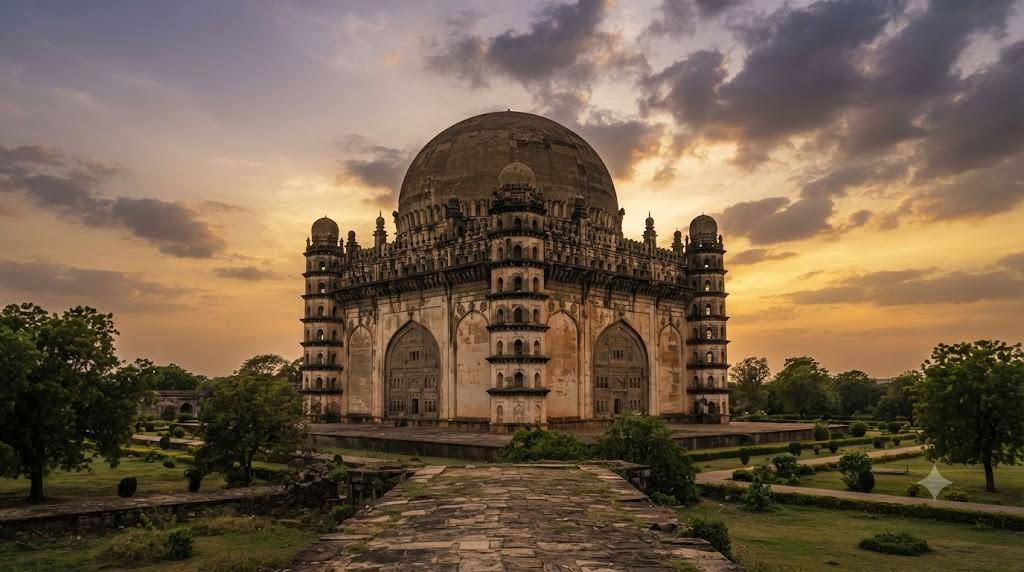
🕌 The Acoustic Wonder of the Deccan: The Colossus of Mohammed Adil Shah
Rising majestically over the northern plains of Karnataka in the historic city of Vijayapura (Bijapur), Gol Gumbaz stands as one of the most astonishing architectural and acoustic triumphs in world history. Housing the mausoleum of Sultan Mohammed Adil Shah (reigned 1627–1656 CE), this colossal monument features the second-largest unsupported dome in the world (surpassed only by St. Peter’s Basilica in Rome), constructed without a single central pillar, crowned by an acoustic Whispering Gallery where a faint whisper echoes eleven distinct times across fifty meters of open space.
In the rich architectural tapestry of India, the city of Vijayapura (historically known as Bijapur, meaning ‘The City of Victory’) occupies an exalted, singular pinnacle. Serving as the imperial capital of the Adil Shahi Dynasty from 1489 to 1686 CE, Bijapur became a world-renowned cultural and artistic metropolis that rivaled contemporary Mughal Delhi and Safavid Isfahan. Under enlightened sovereigns like Ibrahim Adil Shah II and Mohammed Adil Shah, the court fostered profound religious tolerance, classical Indian and Persian music, and an architectural style characterized by colossal hemispherical domes, slender minarets, intricate floral plasterwork, and groundbreaking acoustic engineering.
The Adil Shahi Dynasty: The Cosmopolitan Sultans of the Deccan
The Adil Shahi dynasty was founded in 1489 CE by Yusuf Adil Shah, an aristocratic Persian or Ottoman noble who broke away from the fracturing Bahmani Sultanate to establish an independent sovereign monarchy in northern Karnataka. The Adil Shahis distinguished themselves from northern contemporary rulers through their deep integration into regional Deccan culture, their active patronage of both Shia and Sunni scholars, and their profound appreciation for indigenous Marathi and Kannada vernacular traditions.
The golden age of Bijapur reached its cultural zenith under Ibrahim Adil Shah II (reigned 1580–1627 CE), celebrated by his subjects as Jagadguru Badshah (World Teacher King). A gifted musician, poet, and calligrapher, Ibrahim composed the acclaimed classical musical treatise Kitab-i-Navras (‘The Book of Nine Essences’), opening the work with sacred invocations to both Goddess Saraswati and Prophet Muhammad, demonstrating the profound syncretic harmony that defined the court. It was Ibrahim’s son and successor, Mohammed Adil Shah, who resolved to construct a burial monument of such colossal magnitude that it would dwarf every existing structure in the Deccan.
The Conception of Gol Gumbaz: Competing With Eternity
Commissioned immediately upon Mohammed Adil Shah’s accession in 1627 CE, Gol Gumbaz (literally ‘The Round Dome’) took over thirty years of continuous labor to construct under the direction of master architect Yaqut of Dabul. The sultan was determined that his tomb would surpass the architectural elegance of his father’s mausoleum (the Ibrahim Rouza), choosing colossal scale and sheer acoustic audacity over delicate surface ornamentation.
The monument was constructed of dense dark grey basalt masonry, standing upon a massive square podium fifty meters on each side. Rather than utilizing external flying buttresses or internal colonnades, Yaqut of Dabul engineered an unprecedented internal interlocking system of intersecting stone squinch arches that allowed a massive circular dome measuring forty-four meters (one hundred and forty-four feet) in exterior diameter to rest securely over a completely open, column-free interior floor area of eighteen thousand square feet—the largest single enclosed space in the world at the time of its completion.
| Architectural Dimension | Gol Gumbaz Metric | Global Architectural Comparison | Structural Engineering Significance |
|---|---|---|---|
| Exterior Dome Diameter | 44.0 meters (144 feet) | Second only to St. Peter’s Basilica (Rome) | Largest unsupported circular dome in the Islamic world |
| Internal Floor Area | 1,700 sq. meters (18,200 sq. ft) | Completely open, zero load-bearing pillars | Largest uninterrupted interior chamber in the pre-modern world |
| Overall Monument Height | 51.0 meters (167 feet) | Equivalent to a modern 17-story skyscraper | Dominates the Deccan skyline for 20 kilometers |
| Corner Octagonal Minarets | 8-sided, 7 stories high | Tapering towers with interior spiral staircases | Provides structural counter-weight to lateral dome thrust |
| Whispering Gallery Acoustic | Repeats sounds 10 to 11 times | Reverberation time approx. 26 seconds | Exceptional acoustic resonance across 50 meters diameter |
The Structural Engineering of the Great Unsupported Dome
The greatest structural triumph of Gol Gumbaz resides in how its master builders resolved the complex physics of rotational load distribution. In classical architecture, transitioning from a square floor chamber to a circular dome presents a formidable structural challenge: the lateral thrust of a hemispherical dome exerts enormous outward pressure that tends to buckle exterior walls.
The Intersecting Squinch Arch System
Yaqut of Dabul solved this problem by creating a brilliant geometric network of eight intersecting arches inside the upper chamber. Each arch springs from the face of one wall and crosses over to the opposite corner, creating two interlocking squares rotated at forty-five degrees to form an eight-pointed star.
This ingenious squinch system accomplished three structural miracles simultaneously:
- Even Weight Distribution: It channeled the immense downward weight of the multi-thousand-ton basalt dome directly into the four massive exterior walls, which are each over three meters (ten feet) thick.
- Elimination of Internal Pillars: By distributing the weight entirely through the outer perimeter walls, the interior of the hall remained completely open and unencumbered by central columns.
- The Four Octagonal Minarets as Buttresses: At each of the four exterior corners of the building stands an eight-sided, seven-story octagonal minaret. Beyond their aesthetic elegance, these heavy stone minarets act as colossal vertical structural counterweights, pinning down the corners of the walls to neutralize any residual outward thrust from the dome.
🏗️ Engineering Insight: The Concrete Mass
The dome of Gol Gumbaz was not constructed by assembling dry stone blocks; it was cast as a monolithic shell of high-grade hydraulic lime concrete over five feet thick, reinforced with interlocking stone bonds. This monolithic construction prevented seasonal cracking and contributed directly to its extraordinary acoustic properties.
The Acoustic Marvel: Inside the Whispering Gallery
Ascending one of the winding stone spiral staircases housed inside the corner minarets brings visitors to the base of the interior dome, approximately thirty-three meters above the floor. Here, a narrow cantilevered stone gallery—three meters wide—wraps around the entire internal circumference of the dome: the world-famous Whispering Gallery.
The acoustic properties of this circular gallery are miraculous, representing one of the finest natural acoustic amplification chambers on Earth:
Acoustic Amplification and Eleven-Fold Echoes
If a person stands on one side of the gallery and whispers softly facing the curved wall, their whisper can be heard with absolute crystal clarity by a listener standing directly opposite—over forty meters away across the empty chasm of the hall. The sound waves do not disperse into the center of the hall; instead, they are captured by the smooth curvature of the concave concrete dome, hugging the interior surface like a natural acoustic wave-guide.
Furthermore, a single sharp sound—such as a single handclap or the click of fingers—is not heard once; it is reflected back and forth between the concave walls, generating a sequence of ten to eleven distinct, diminishing echoes before fading into silence over a reverberation span of nearly twenty-six seconds. Architectural historians believe this acoustic effect was deliberately calculated by Yaqut of Dabul so that prayers recited by Muslim clerics inside the gallery would reverberate continuously, creating an acoustic illusion of eternal cosmic prayer echoing around the tomb of the sultan.
| Acoustic Phenomenon | Physical Mechanism | Observable Effect | Acoustic Metric |
|---|---|---|---|
| Convex Wave Guiding | Sound waves cling to concave dome curve | Faint whisper heard clearly across 40m distance | Near-zero signal dispersion over distance |
| Multiple Discrete Echoes | Opposite wall reflection cycles | Single handclap repeats 10 to 11 times | 26-second total reverberation decay time |
| Resonant Frequency Tuning | Dimensions match low vocal fundamentals | Vocal chanting naturally amplifies in volume | Mimics natural electronic acoustic reverb |
| Directional Isolation | Whispering into wall focuses audio beam | Listener across the dome hears sound in ear | Stereo-like localized audio focus |
Other Architectural Masterpieces of Bijapur: The Ibrahim Rouza and Malik-e-Maidan
While Gol Gumbaz represents the climax of monumental scale, Vijayapura preserves an extraordinary matrix of palaces, mosques, and artillery that showcase the multifaceted genius of the Adil Shahi era:
The Ibrahim Rouza (The Black Taj of the Deccan): Completed in 1627 CE as the mausoleum of Ibrahim Adil Shah II and his queen Taj Sultana, this complex is widely hailed by art historians as the inspiration for the Taj Mahal in Agra. Unlike the heavy austerity of Gol Gumbaz, the Ibrahim Rouza is a breathtaking jewel of delicate stone filigree. Its walls, perforated stone windows, and vaulted ceilings are covered in micro-carved Arabic calligraphy, hanging stone chains carved from single blocks of rock, and slender minarets topped with delicate lotus finials.
The Malik-e-Maidan (The Monarch of the Battlefield): Perched atop the Burj-e-Sherz (Lion Bastion) along the fort walls sits one of the largest medieval cast-bronze cannons on Earth: the Malik-e-Maidan. Cast in 1549 CE in Ahmadnagar from fifty-five tons of bell metal (an alloy of copper, tin, and zinc), the muzzle of the cannon is sculpted into the open jaws of a roaring lion devouring an elephant. The bronze remains cool to the touch even under blistering summer sun, emitting a clear musical chime when struck with a wooden mallet.
The Asar Mahal and Gagan Mahal: The Asar Mahal, constructed in 1646 CE as a palace of justice, once housed two sacred hairs of the Prophet Muhammad, renowned for its painted wooden ceiling frescoes and deep reflecting pool. Nearby stands the Gagan Mahal (Sky Palace), built in 1561 CE with a massive sixty-foot central arch that served as the royal durbar hall where Sultan Ali Adil Shah I reviewed his armies.
💧 Hydraulic Legacy: The Taj Bawdi Step-Well
Bijapur possessed an advanced underground water system fed by the historic Taj Bawdi. Built in 1620 CE in honor of Queen Taj Sultana, this massive square step-well descends through arched galleries into a deep natural spring, providing over fifty thousand gallons of pure water daily to the city’s inhabitants.
Visitor Guidance, Acoustics Etiquette, and Travel Logistics
Exploring the monumental heritage of Vijayapura is an intellectually and sensory exhilarating experience that rewards thoughtful travel preparation:
- Experience the Whispering Gallery Early: To experience the true acoustic miracle of the Whispering Gallery, arrive at Gol Gumbaz at 6:00 AM when the gates first open. Once school groups and daytime crowds arrive, the gallery fills with loud shouting and whistling, which overloads the acoustic resonance and makes subtle whisper-testing impossible. Early morning offers silent, meditative acoustic perfection.
- Comfortable Minaret Ascent: The climb to the Whispering Gallery involves ascending approximately one hundred narrow, winding stone steps inside the octagonal corner minarets. Wear comfortable flat walking shoes, watch your step on polished stone thresholds, and take steady breaths during the ascent.
- Connectivity and Exploration Season: Vijayapura is well-connected by express trains to Bengaluru, Mumbai, and Hyderabad. The optimal exploration window spans from October through February, when pleasant winter breezes temper the arid Deccan heat, making full-day walking tours across the fort monuments delightful.
In conclusion, Gol Gumbaz and the monuments of Bijapur stand as an eternal testament to the intellectual daring, mathematical genius, and architectural cosmopolitanism of the medieval Deccan. Standing in the silent center of that colossal, unsupported dome as an ancient whisper echoes through the darkness above, one is filled with deep awe for the master builders of Vijayapura who proved that stone and geometry could unite to capture the music of the cosmos.
The Royal Tombs of the Queens and the Architectural Matrix of Bijapur
Complementing the masculine monumentalism of Gol Gumbaz is the sophisticated feminine architecture preserved within Bijapur’s royal enclosures, most notably the Mausoleum of Chand Bibi and the Jahan Begum Tomb at Ainapur. Chand Bibi, the legendary queen regent who heroically defended Ahmadnagar and Bijapur against the imperial armies of Mughal Emperor Akbar, remains an immortal symbol of female leadership and diplomatic brilliance in Deccan history.
The city’s urban matrix was framed by an expansive twelve-kilometer circular stone defense wall containing ninety-six colossal bastions, five major ornamental gateways, and a deep defensive moat. Interspersed within these walls were public hammams, hydraulic pressure towers (Bawdis) that regulated water distribution from the Begum Talab reservoir, and sprawling open-air gardens that transformed this arid northern plain into a lush, thriving oasis of medieval cosmopolitanism.
🎶 Musical Heritage: The Kitab-i-Navras Legacy
The intellectual soul of Bijapur resides in the musical compositions of Sultan Ibrahim Adil Shah II. In his Kitab-i-Navras, the sultan pioneered the integration of classical Indian ragas (such as Bhairavi and Asavari) with Persian poetic meters, praising the lute (Tanpura) as the divine bridge between human souls and the infinite cosmos.