👑 Imperial Hegemony: The Shield of Southern Dharma
Established in 1336 CE along the rugged granite banks of the Tungabhadra River, the Vijayanagara Empire emerged as one of the most powerful, cosmopolitan, and wealthy medieval empires in global history. Under legendary sovereigns such as Emperor Krishnadevaraya, the empire coordinated international maritime commerce from Portugal to Malacca, fostered brilliant Kannada and Telugu literary renaissances, and developed an indestructible urban citadel that astonished European and Persian ambassadors.
The historical trajectory of South India was decisively transformed in the fourteenth century with the foundation of the Vijayanagara Empire, known in contemporary Sanskrit and Kannada inscriptions as Karnata Rajya. Founded by the Sangama brothers Harihara I and Bukka Raya I under the spiritual guidance of the venerated sage Vidyaranya, the empire arose in response to the political instability caused by northern invasions into the Deccan. For over two and a half centuries, Vijayanagara served as a colossal bulwark that preserved, revitalized, and elevated traditional South Indian arts, Sanskrit philosophical discourses, vernacular literatures, and temple building traditions.
Geopolitical Foundation: The Strategic Geography of Kishkindha
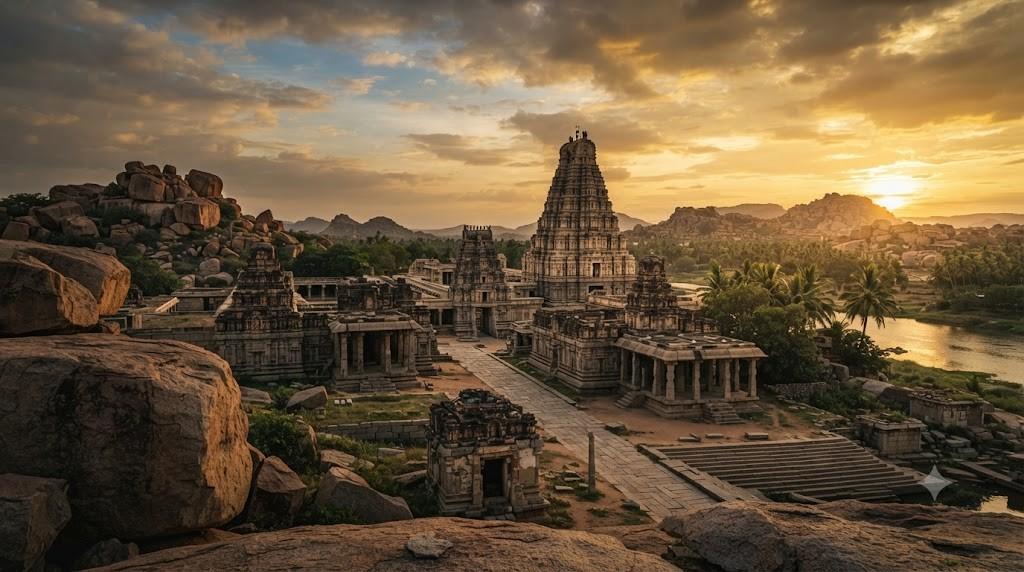
The selection of Hampi (historically known as Pampa Kshetra and identified with the mythical monkey kingdom of Kishkindha from the Ramayana) as the imperial capital was a masterpiece of military geography. Encircling the southern bank of the rapid Tungabhadra River, the site was naturally fortified by massive granite boulder hills—such as Matanga, Hemakuta, Malyavanta, and Anjanadri—that formed impassable physical barriers against mounted cavalry incursions.
Vijayanagara military engineers incorporated these granite outcrops into a formidable network of seven concentric defensive stone wall circuits. Interspersed between these ramparts were deep moats, massive bastions, heavily guarded gateway complexes with right-angled dogleg passages to trap charging enemy war elephants, and vast agricultural storehouses that allowed the city to withstand prolonged sieges without starving. Portuguese traveler Domingo Paes, visiting the metropolis during its zenith around 1520 CE, recorded that the city was as vast as Rome, with a population exceeding half a million inhabitants, filled with opulent stone mansions, landscaped pleasure gardens, and vibrant commercial avenues.
The Dynastic Lineages: From Sangama to Aravidu
The sovereign authority of the empire was steered through four successive ruling dynasties, each contributing distinct military adaptations and institutional reforms to the state:
- The Sangama Dynasty (1336–1485 CE): Established by Harihara and Bukka, this foundational lineage consolidated the Deccan plateau, subdued the Hoysala remnants, and integrated coastal Karnataka ports into imperial administrative networks under visionary monarchs like Deva Raya II.
- The Saluva Dynasty (1485–1505 CE): Founded by Saluva Narasimha, this brief military interregnum stabilized the realm during severe frontier revolts and secured crucial coastal horse trade monopolies against rival Deccan sultanates.
- The Tuluva Dynasty (1505–1570 CE): The golden age of imperial expansion. Led by Emperor Krishnadevaraya (reigned 1509–1529 CE) and his successor Achyuta Deva Raya, the Tuluva era marked the zenith of territorial boundaries, architectural splendor, and cultural achievements.
- The Aravidu Dynasty (1570–1646 CE): Following the cataclysmic battle of Talikota, the imperial capital shifted to Penukonda and later Chandragiri, maintaining decentralized resistance across southern India for another century.
| Imperial Dynasty | Reign Span | Key Sovereigns | Major Military Milestones | Cultural & Architectural Contributions |
|---|---|---|---|---|
| Sangama | 1336–1485 CE | Harihara I, Bukka I, Deva Raya II | Consolidation of Karnataka, defense against Bahmanis | Virupaksha expansion, recruitment of archers, Vidyaranya patronage |
| Saluva | 1485–1505 CE | Saluva Narasimha Raya | Suppression of internal rebellions, coastal port security | Restoration of Vaishnavite temple lands, Arabian horse trade |
| Tuluva | 1505–1570 CE | Krishnadevaraya, Achyuta Raya | Annexation of Raichur doab, conquest of Udayagiri & Kondavidu | Vittala Temple, Hazara Rama, Kannada & Telugu epic poetry |
| Aravidu | 1570–1646 CE | Tirumala, Venkatapati Raya II | Post-Talikota defense from Penukonda and Chandragiri | Support for regional Nayaka kingdoms in Madurai and Tanjore |
Administrative Genius: The Nayankara System and Hydraulic Grids
The military and fiscal longevity of the Vijayanagara Empire rested upon a highly structured feudal-military administrative framework known as the Nayankara System (Amara-Nayaka system). Under this arrangement, the emperor assigned defined territorial tracts (amara fiefs) to provincial military governors titled Nayakas.
In exchange for the revenues generated from their territories, the Nayakas were legally obligated to maintain a specified contingent of infantry, cavalry, and trained war elephants ready for imperial deployment at immediate notice. Furthermore, Nayakas were required to submit an annual tribute to the imperial treasury during the grand ten-day Mahanavami festival held at Hampi. This decentralized system combined localized administrative vigilance with immense, rapid military mobilization capabilities.
Hydraulic Engineering and Agricultural Expansion
Sustaining half a million citizens in the arid rain-shadow zone of central Karnataka demanded extraordinary hydraulic ingenuity. Vijayanagara engineers constructed a vast network of stone check-dams (anicuts) across the turbulent Tungabhadra River, diverting river water into perennial contour canals that fed agricultural terraces across the city.
The Kamalapuram Tank, a colossal reservoir built during the reign of Krishnadevaraya, supplied drinking water to the royal palaces through subterranean terracotta pipes while irrigating thousands of acres of sugarcane, banana, and paddy fields. Within the urban core, stepped masonry tanks such as the Pushkarani featured interlocking black chlorite slabs transported from distant quarries, filled through channeled aqueducts that operated purely on gravitational slope gradients without mechanical pumps.
📜 Ambassadorial Chronicles: Abdul Razzaq’s Impressions
Persian ambassador Abdul Razzaq, visiting Hampi in 1443 CE, wrote with profound astonishment: ‘The city of Bijanagar is such that the eye has not seen nor ear heard of any place to equal it on the whole earth. It is so built that it has seven concentric circles of walls… The jewelers sell pearls, rubies, diamonds, and emeralds openly in the central bazaars.’
The Emperor Krishnadevaraya: Scholar-King, Conqueror, and Patron
Ascending the diamond throne in 1509 CE, Emperor Krishnadevaraya personified the ideal Indian philosopher-king (Rajarshi). A brilliant military tactician, Krishnadevaraya personally led his armies to decisive victories against the Sultan of Bijapur, captured the impregnable fortress of Raichur, and subdued the Gajapatis of Odisha, expanding the empire from the Arabian Sea to the Bay of Bengal.
Yet his military conquests were rivaled by his intellectual and literary brilliance. A polyglot scholar proficient in Kannada, Sanskrit, and Telugu, Krishnadevaraya authored the acclaimed Telugu political epic Amuktamalyada, which outlines his sophisticated philosophy of statecraft, environmental management, and justice. In it, he famously declared that a king must spend revenues on building irrigation reservoirs and protecting foreign merchants to secure the prosperity of his subjects.
The Ashta Diggajas: Literary Renaissance
The imperial court at Hampi, known as the Bhuvana Vijayam, was illuminated by the Ashta Diggajas (Eight Celestial Elephants)—a circle of eminent poets and scholars. Among them, Allasani Peddana and the witty court advisor Tenali Ramakrishna shaped South Indian literary traditions through masterworks of narrative poetry, satire, and philosophical allegory. Krishnadevaraya generously endowed major pilgrimage temples across South India—constructing the towering northern gopuram at Chidambaram, massive pillared halls at Tirupati Balaji, and the monumental Krishna Temple at Hampi.
Architectural Synthesis: The Vijayanagara Style
Vijayanagara architecture was not a mere continuation of earlier Dravidian forms; it represented a bold, theatrical synthesis of traditional South Indian styles with emerging Deccan sultanate influences, creating what scholars categorize as the imperial Vijayanagara Style.
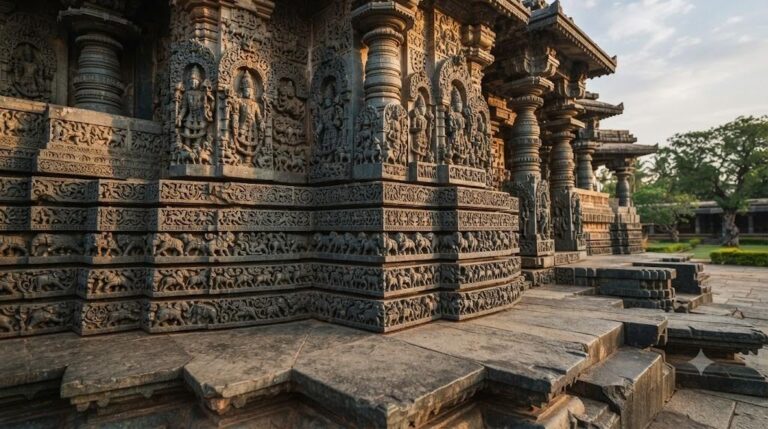
The most distinctive signature of Vijayanagara religious architecture is the Kalyana Mandapa (marriage hall). Built within temple enclosures to celebrate the divine wedding of deities, these open-pillared halls feature monumental monolithic granite columns carved with rearing mythological beasts known as Yalis (part-lion, part-elephant, part-horse) ridden by muscular warriors. Below these rearing beasts, the columns branch into slender acoustic shafts and intricate miniature sculptures depicting musicians and celestial nymphs.
Civil Architecture: Indo-Islamic Aesthetic Harmony
While religious structures strictly adhered to classical Hindu canonical treatises (Shilpa Shastras), civil and military architecture within the Royal Centre revealed bold, pragmatic cross-cultural syncretism:
- The Lotus Mahal (Chitrangi Mahal): A graceful two-story secular pavilion set within the Zenana enclosure. Built with lime-plastered brick masonry, the structure combines recessed multi-foliated Islamic cusped arches and ribbed vaults with traditional Hindu stepped roofs, overhanging eaves (chhajjas), and carved lotus bud finials.
- The Elephant Stables: A colossal domed structure consisting of eleven vaulted chambers designed to house the emperor’s prized royal war elephants. Each central chamber is crowned by a distinct Islamic dome style—ranging from ribbed onion domes to fluted octagonal pyramids—demonstrating the court architects’ fluent mastery of Deccan Islamic engineering.
- The Mahanavami Dibba: A massive three-tiered square stone platform rising twelve meters high. From this elevated ceremonial summit, the emperor observed military parades, royal wrestling matches, and religious rituals during the autumn festival. The outer stone tiers are covered with relief friezes portraying foreign emissaries in Persian attire, Chinese ceramic trade, camel caravans, and dancing troupes.
| Monument / Structure | Functional Classification | Structural Materials | Stylistic Hallmarks | Historical Significance |
|---|---|---|---|---|
| Vijaya Vittala Temple | Religious Sanctum | Granite & Chlorite | Musical pillars, stone chariot, expansive bazaar street | Culmination of late Vijayanagara granite stonecraft |
| Virupaksha Temple | Living Religious Center | Granite, Brick, Stucco | 50-meter eastern gopuram, optical pinhole chamber | Oldest continuously worshiped shrine in Hampi |
| Lotus Mahal | Royal Pleasure Pavilion | Stone, Lime Plaster, Terracotta | Cusped arches, ribbed vaulting, stepped lotus finials | Supreme example of Indo-Islamic courtly syncretism |
| Elephant Stables | Military Infrastructure | Ashlar stone, Brick, Mortar | Eleven interlinked domed chambers with varying arches | Showcases cosmopolitan architectural tolerance |
| Mahanavami Dibba | Imperial Ceremonial Platform | Granite cyclopean blocks | Deep narrative bas-reliefs of foreign trade and martial drills | Symbol of sovereign authority during Mahanavami festivals |
The Cataclysm of Talikota and the Eternal Legacy of Hampi
The golden age of Vijayanagara came to a tragic, abrupt halt in January 1565 CE at the fateful Battle of Talikota (Rakshasi-Tangadi). Confronted by a unified coalition of the four Deccan Sultanates (Bijapur, Golconda, Ahmadnagar, and Bidar), the imperial army under ninety-year-old regent Aliya Rama Raya was betrayed by mercenary commanders on the battlefield, leading to catastrophic defeat.
Following the battle, the defenseless capital of Hampi was abandoned by the royal family and subjected to months of systematic looting, burning, and structural demolition. The magnificent wooden palace superstructures were incinerated, delicate stone sculptures defaced, and the bustling diamond bazaars deserted. Yet, despite centuries of destruction, the granite skeleton of Hampi refused to perish.
Today, the sprawling ruins of Hampi stand as a designated UNESCO World Heritage site, drawing historians, pilgrims, and global travelers to its dramatic boulder landscapes. The memory of Vijayanagara endures as a radiant symbol of Indian civilizational resilience—a majestic testament to an empire that defended South Indian heritage, pioneered global commerce, and etched its glorious soul onto the eternal granite of the Deccan.
The Military Revolution: Gunpowder, Cavalry, and Fortification Engineering
A vital yet frequently under-examined facet of Vijayanagara’s imperial longevity was its proactive embrace of early modern military technology. Long before the widespread adoption of matchlocks across northern India, the sovereigns of Vijayanagara recognized that traditional infantry levies were insufficient against mobile cavalry and early artillery employed by the Deccan sultanates.
Under monarchs like Deva Raya II and Krishnadevaraya, the imperial military administration recruited Turkish and Portuguese mercenary gunners, establishing specialized firearm manufacturing foundries within the capital. Stone cannonballs, iron swivel guns, and wall-mounted bombards were integrated into the defensive bastions of Hampi. Furthermore, to overcome the critical shortage of high-quality domestic horses in tropical South India, Vijayanagara established an exclusive maritime alliance with Portuguese governor Afonso de Albuquerque in Goa. By securing the sole monopoly over imported Arabian and Persian war horses arriving at the ports of Bhatkal and Honnavar, Emperor Krishnadevaraya ensured that his elite cavalry units could outmaneuver rival forces on the battlefield.
The Daily Life and Urban Fabric of Hampi’s Citizens
Contemporary chronicles by foreign visitors—including Italian merchant Niccolò de’ Conti, Portuguese chroniclers Fernão Nunes and Domingo Paes, and Russian adventurer Afanasy Nikitin—provide vivid snapshots of the vibrant daily life within the imperial metropolis. The city was not merely an administrative fortress; it was a teeming commercial hub filled with cosmopolitan diversity.
Citizens enjoyed sophisticated public amenities, including multi-tiered public baths, tree-lined avenues illuminated by oil lamps during festival seasons, and extensive community feeding houses (annachatras) funded by merchant guilds. Women occupied exceptionally prominent roles in Vijayanagara civil and courtly life: contemporary records document female royal bodyguards, wrestlers, astrologers, accountants, literary poets, and musicians who held salaried appointments within the imperial household, reflecting an enlightened social fabric rare in the medieval world.
💎 Economic Legacy: The Global Diamond Monopoly
During the fifteenth and sixteenth centuries, the Vijayanagara Empire controlled the world’s most productive diamond mines along the Krishna and Tungabhadra river basins (including Kollur and Vajrakarur). Hampi functioned as the undisputed global clearinghouse for precious gems, attracting Venetian gem merchants, Persian jewelers, and Chinese silk traders.