🐅 Ecological Stronghold: The Heartland of Asiatic Wildlife
Karnataka harbors the largest contiguous population of wild Asian elephants and Bengal tigers anywhere on the planet. Encompassing core bastions of the UNESCO-designated Western Ghats and the Nilgiri Biosphere Reserve, the state’s protected forest matrix stands as an international beacon of conservation biology, habitat connectivity, and thrilling safari expeditions.
From the mist-draped tropical evergreen canopy of the Sahyadri mountains to the deciduous teak forests bordering the Kabini River, Karnataka preserves an astonishing ecological sanctuary. For wildlife biologists, conservationists, wildlife photographers, and nature seekers, venturing into Karnataka’s national parks and sanctuaries offers unmatched encounters with charismatic megafauna. Understanding the ecological dynamics, seasonal animal movements, tracking protocols, and conservation challenges of these reserves is vital for an unforgettable wildlife voyage.
The Western Ghats Ecosystem: A Global Biodiversity Epicenter
The Western Ghats, forming the western spine of Karnataka, represent an ancient mountain range older than the Himalayas. Inscribed as a UNESCO World Heritage natural site, this mountain chain intercepts the moisture-laden southwest monsoon winds, generating high-volume rivers that sustain over three hundred million people across South India. The mountains shelter over five thousand species of flowering plants, one hundred and thirty-nine mammal species, five hundred bird species, and one hundred and seventy-nine amphibian species—more than half of which are endemic and found nowhere else on Earth.
Within Karnataka, this biodiversity hotspot transitions gradually from moist tropical evergreen forests along the windward slopes into semi-evergreen and dry deciduous woodlands on the leeward plateau. This environmental gradient creates varied micro-habitats that support diverse animal guilds, from the arboreal lion-tailed macaque to the terrestrial Indian pangolin, four-horned antelope (chausingha), and king cobra.
The Nilgiri Biosphere Reserve: Cross-Border Habitat Continuity
The crown jewel of Karnataka’s wildlife network is its southern forest corridor, forming an integral part of the Nilgiri Biosphere Reserve—India’s first UNESCO biosphere reserve established in 1986. Spanning over five thousand five hundred square kilometers across Karnataka, Kerala, and Tamil Nadu, this transboundary conservation zone ensures that wide-ranging mega-herbivores and apex predators can migrate freely across seasonal river basins without encountering catastrophic ecological fragmentation.
| National Park / Sanctuary | Area (sq km) | Dominant Forest Type | Flagship Species | Best Wildlife Sighting Period |
|---|---|---|---|---|
| Nagarhole (Rajiv Gandhi NP) | 643 sq km | Moist deciduous & teak forest | Bengal tiger, Black panther, Asian elephant | October to May |
| Bandipur National Park | 874 sq km | Dry deciduous scrub & rosewood | Tiger, Gaur (Indian bison), Sambar deer | November to April |
| Kudremukh National Park | 600 sq km | Evergreen rainforest & Shola grassland | Lion-tailed macaque, Malabar civet, Leopard | October to March |
| Bhadra Wildlife Sanctuary | 492 sq km | Dry & moist bamboo brakes | Leopard, Elephant, Malabar giant squirrel | November to April |
| Anshi / Kali Tiger Reserve | 1,300 sq km | Dense evergreen canopy | Black panther, Great hornbill, King cobra | October to April |
Nagarhole National Park: The Legend of the Kabini Backwaters
Encompassing six hundred and forty-three square kilometers in Kodagu and Mysore districts, Nagarhole National Park (officially Rajiv Gandhi National Park) takes its evocative name from the Kannada words ‘Naga’ (snake) and ‘Hole’ (stream), describing the winding perennial waterways that carve through its lush teak and rosewood canopy.
The ecological heartbeat of Nagarhole centers around the expansive Kabini Reservoir, created by damming the Kabini River. During the dry pre-monsoon months from February to May, peripheral grasslands along the receding backwaters become one of the largest seasonal congregations of Asian elephants in the world. Hundreds of elephants gather in multi-generational family herds to bathe, feed on tender young grasses, and engage in complex social interactions.
Predator Dynamics: Tigers, Leopards, and the Fabled Black Panther
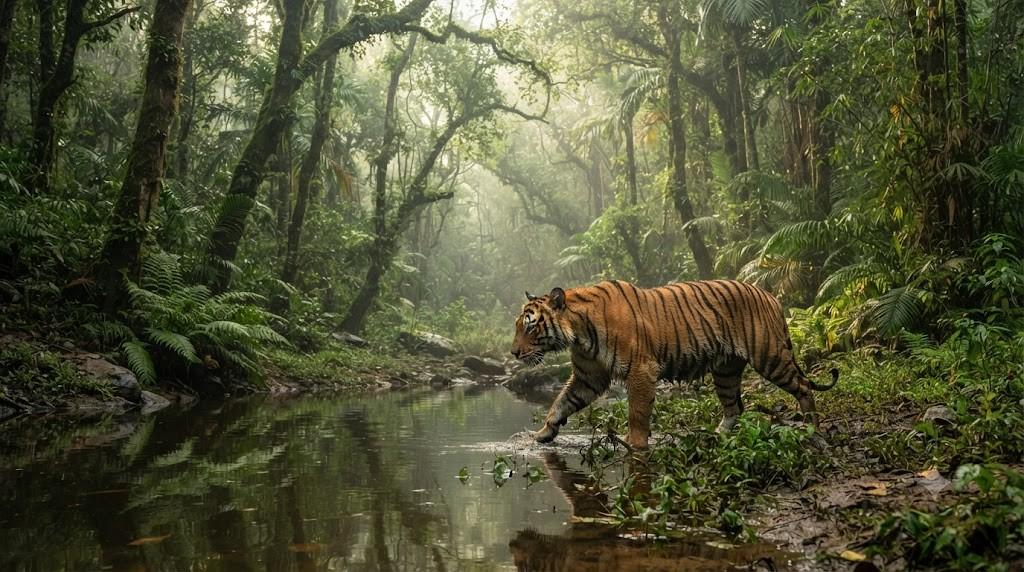
Nagarhole maintains one of the highest tiger densities in India, sustained by a phenomenal prey base of chital (spotted deer), sambar, barking deer, wild boar, and Indian gaur. The park is equally renowned for its high concentration of Indian leopards (Panthera pardus fusca), which have adapted to navigate the dense canopy to avoid direct conflict with dominant tigers.
Over the past decade, the Kabini tourism zone of Nagarhole has achieved worldwide celebrity among naturalists for the presence of a resident melanistic leopard (black panther) named ‘Saya’. The black panther’s dark coat is caused by a recessive genetic mutation called melanism, which causes an overproduction of melanin pigment while retaining the animal’s signature rosette markings visible beneath direct sunlight. Watching this phantom predator stalk silently through sun-dappled bamboo thickets represents one of the most thrilling wildlife spectacles in the world.
🚤 Safari Protocol: Vehicle and Boat Safaris
Nagarhole operates two distinct safari modalities managed by Jungle Lodges and Resorts and the Karnataka Forest Department. Jeep safaris penetrate deep into terrestrial deciduous tracks for big cat tracking, while motorized boat safaris navigate the Kabini backwaters, offering close-range photographic encounters with swimming elephant herds, marsh crocodiles (muggers), and smooth-coated otters.
Bandipur National Park: Sandalwood Scents and Tiger Corridors
Situated fifty kilometers south of Mysuru along the foothills of the Nilgiri hills, Bandipur National Park encompasses eight hundred and seventy-four square kilometers. Originally designated as the private venery of the Maharajas of Mysore in 1931, Bandipur became one of the original nine tiger reserves established under Prime Minister Indira Gandhi’s landmark Project Tiger initiative in 1973.
Unlike the moist, humid canopy of Nagarhole, Bandipur features predominantly dry deciduous scrub, open woodlands, and stands of fragrant wild sandalwood, golden shower (Cassia fistula), and axle-wood trees. This open vegetation structure dramatically enhances visibility for tracking large animals over long distances.
The Gaur and the Dhole: Master Hunters of the Scrub
Bandipur is home to colossal herds of the Indian Gaur (Bos gaurus), the world’s largest bovine species, with adult bulls weighing upwards of one thousand kilograms and sporting muscular humps and distinctive white stockings. These gentle giants graze peacefully alongside spotted deer and peafowl.
Equally fascinating is Bandipur’s thriving population of Dholes (Asiatic wild dogs). Highly social, cooperative pack hunters, dholes hunt with relentless endurance, communicating across dense scrub using high-pitched bird-like whistles and chirps. A pack of ten to fifteen dholes can successfully bring down prey as large as a full-grown sambar, maintaining crucial evolutionary pressure on herbivore populations.
Specialized Sanctuaries: High Altitudes, Rivers, and Avian Sanctuaries
Beyond the famous tiger reserves of the southern plateau, Karnataka protects numerous specialized ecological sanctuaries dedicated to rare species, river habitats, and migratory birds:
- Kudremukh National Park: Located in the high-altitude rainfall belt of Chikmagalur, Kudremukh features rolling tropical montane grasslands interspersed with dense Shola stunted cloud forest patches. It serves as a sanctuary for the endangered Lion-Tailed Macaque (Macaca silenus), an arboreal primate distinguished by its silver-white mane and black coat, which feeds exclusively on wild canopy figs and rainforest fruits.
- Ranganathittu Bird Sanctuary: Situated along the banks of the sacred Cauvery River near Srirangapatna, Ranganathittu is Karnataka’s premier avian breeding sanctuary. A cluster of six rocky islets surrounded by river channels hosts thousands of breeding waterbirds between June and November, including painted storks, Asian openbills, spoonbills, black-headed ibis, and darter birds, alongside resident marsh crocodiles sunning on mid-river rocks.
- Dharoji Sloth Bear Sanctuary: Located near the UNESCO ruins of Hampi in Bellary district, Dharoji protects rugged granite scrub terrain uniquely customized for the Indian Sloth Bear (Melursus ursinus). A specialized cliff-side watchtower allows visitors to observe wild sloth bears clambering down rocky crevices in the late afternoon to feed on sweet mahua flowers, termites, and jaggery pastes provided by forest wardens.
- Kali Tiger Reserve (Dandeli-Anshi): Encompassing the deep valleys of the Kali River in northern Western Ghats, this rainforest stronghold is famous for white-water river rafting, dense hornbill populations (including the majestic Great Pied Hornbill), and rare black panther sightings beneath towering bamboo brakes.
🦅 Avian Highlight: The Malabar Pied Hornbill
The riverine forests of Dandeli and Kali Tiger Reserve represent the largest breeding concentration of the endangered Malabar Pied Hornbill in South India. These majestic birds play an indispensable ecological role as ‘farmers of the forest’, dispersing large seeds from fruiting rainforest trees across vast distances.
Responsible Wildlife Tourism and Conservation Ethics
As wildlife tourism expands across South India, maintaining rigorous ethical protocols during forest incursions is essential to prevent psychological distress to wild animals and protect sensitive breeding grounds. Travelers visiting Karnataka’s wilderness reserves must observe established forest etiquette:
- Strict Safari Discipline: Never disembark from safari vehicles inside reserve territories. Keep conversation volumes to a low whisper, switch mobile phones to silent mode, and avoid wearing brightly colored clothing (opt for muted earthy tones such as khaki, olive green, brown, and beige).
- Ban on Flash Photography: Flash photography is strictly illegal inside all tiger reserves. Blinding artificial lights disorient nocturnal predators, startle nursing elephant mothers, and can provoke defensive mock charges from protective matriarchs.
- Zero Littering and Plastic Bans: Karnataka enforces an absolute ban on single-use plastic bottles and polythene wraps inside national parks. Ingested plastics cause fatal digestive blockages in deer and elephants. Always pack out every piece of refuse generated during forest excursions.
- Support Sustainable Community Lodges: Select eco-certified accommodations like government-managed Jungle Lodges & Resorts (JLR) or certified community homestays that employ local tribal naturalists, reinvest revenues into anti-poaching patrol equipment, and practice solar power and rainwater harvesting.
In conclusion, Karnataka’s wildlife reserves represent one of humankind’s greatest triumphs of ecological stewardship. Standing in an open jeep as the morning mist lifts over the Kabini River, hearing the frantic alarm calls of spotted deer echoing through the teak canopy, and watching a majestic Bengal tiger emerge onto a forest track is a profoundly humbling experience that reconnects travelers with the untamed wonder of the natural world.
The Science of Forest Stratification and Canopy Ecology
To truly understand the extraordinary wildlife densities of Karnataka’s Western Ghats reserves, one must examine the vertical architecture of the forest itself. Tropical rainforests and moist deciduous woodlands are not uniform habitats; they are divided into four distinct vertical ecological layers, each occupied by specialized animal species that have evolved over millions of years to exploit specific ecological niches.
The Emergent Layer: Composed of giant hardwood trees—such as Dipterocarpus, rosewood, and wild fig—that punch through the canopy to reach heights of forty to sixty meters above the forest floor. This sunlit realm is the exclusive territory of aerial predators and specialized frugivores. The majestic Great Pied Hornbill soars between these emergent crowns, while white-bellied sea eagles scan forest clearings for prey.
The Canopy Layer: Formed by a dense, interlocking ceiling of branches and foliage twenty to thirty meters high. Acting like a massive solar panel, the canopy captures ninety percent of sunlight and is home to the vast majority of rainforest animal life. Arboreal mammals such as the endangered Lion-Tailed Macaque, the Nilgiri langur, and the vibrant Malabar Giant Squirrel (Ratufa indica)—with its multi-colored maroon, purple, and cream coat—spend virtually their entire lives leaping between high branches without ever touching the forest floor.
The Understory Layer: A humid, dimly lit realm dominated by shade-tolerant palms, wild ginger, climbing lianas, and dwarf bamboo thickets. This middle stratum serves as the hunting corridor for agile arboreal predators like the Indian leopard, clouded leopard, and the venomous Malabar pit viper (Craspedocephalus malabaricus), whose camouflage allows it to blend seamlessly into green moss and wet foliage.
The Forest Floor: A perpetually damp, leaf-strewn underworld where light rarely penetrates directly. Despite the darkness, this layer is the engine of the entire ecosystem. Army ants, dung beetles, and giant millipedes break down fallen plant matter, while apex terrestrial mammals—including the Royal Bengal tiger, Asian elephant, Indian gaur, and sloth bear—navigate game trails, scent-marking territory and maintaining natural forest clearings.
| Forest Stratum | Elevation Above Ground | Environmental Conditions | Characteristic Fauna | Ecological Role |
|---|---|---|---|---|
| Emergent Layer | 40 to 60+ meters | High sunlight, strong winds, variable humidity | Great Pied Hornbill, Black Eagle, Giant Fruit Bats | Long-distance seed dispersal, canopy predation |
| Canopy Layer | 20 to 35 meters | Dense foliage, high fruit & nectar availability | Lion-Tailed Macaque, Malabar Giant Squirrel, Civets | Primary herbivory, pollination, arboreal biodiversity |
| Understory Layer | 5 to 15 meters | Filtered dim light, high humidity, dense lianas | Leopard, Flying Lizard (Draco), Malabar Pit Viper | Ambush predation, specialized reptile/insect habitat |
| Forest Floor | Ground level | Dark, damp, deep leaf litter, rotting logs | Bengal Tiger, Asian Elephant, Indian Gaur, Sloth Bear | Nutrient recycling, mega-herbivory, apex predation |
The Human-Wildlife Interface: Conservation Technologies and Community Coexistence
Conserving large populations of wide-ranging megafauna in a rapidly developing country like India requires extraordinary managerial dedication and cutting-edge conservation biology. Karnataka’s Forest Department has pioneered innovative technologies and community-centered protocols to mitigate human-wildlife conflict and safeguard endangered species:
- M-STrIPES Digital Patrolling: Field forest guards across Nagarhole, Bandipur, and Bhadra utilize the digital ‘Monitoring System for Tigers – Intensive Protection and Ecological Status’ (M-STrIPES) application. Equipped with GPS-enabled handsets, anti-poaching squads log daily patrol routes, record direct animal sightings, document habitat disturbances, and instantly flag wire snares or unauthorized human incursions.
- Solar Fence and Railway Barricade Corridors: To prevent wild elephant herds from wandering into peripheral agricultural sugarcane and banana fields—which frequently leads to retaliatory crop-raiding conflicts—Karnataka has constructed hundreds of kilometers of high-tensile railway line barricades and solar-powered electric fencing. These physical deterrents keep elephants within protected core reserves while allowing smaller wildlife to cross unobstructed.
- Tribal Naturalist Empowerment: Indigenous tribal communities such as the Jenu Kurubas and Betta Kurubas have inhabited the forests of the Western Ghats for millennia. Possessing unmatched traditional ecological knowledge—including the ability to identify distant predator alarm calls, track pugmarks in dry soil, and locate subterranean water sources—tribal members are formally employed as lead trackers, safari guides, and frontline anti-poaching watchers, aligning community welfare with ecological preservation.
🐾 Naturalist Note: Decoding Jungle Alarm Calls
During a forest safari, seasoned naturalists rely heavily on animal acoustics rather than direct sight. A sharp, repetitive bark from a spotted deer (Chital) typically signals a tiger on the move, while the sudden booming honk of a Nilgiri langur high in the canopy warns of a leopard stalking through the lower branches. Learning to decode these alarm calls transforms a simple drive into an exhilarating real-time detective mystery.
Seasonal Wildlife Calendars and Photography Planning
Maximizing the photographic and observational success of a wildlife expedition in Karnataka requires aligning your visit with seasonal animal behavior and micro-climatic conditions:
- The Pre-Monsoon Dry Months (March to May): While temperatures can be warm, this is the indisputable golden season for large mammal photography. As smaller seasonal streams and interior waterholes dry up, animals are compelled to congregate along perennial reservoirs like the Kabini and Bhadra backwaters. Sparse foliage improves sightlines through the forest, making it easier to track elusive predators.
- The Post-Monsoon Green Awakening (October to December): Immediately following the southwest monsoon, the forests are transformed into a vibrant emerald wonderland. While animal tracking requires greater patience due to dense leaf cover and dispersed water sources, the landscape offers spectacular macro photography opportunities—including vibrant fungi, rare orchids, mating endemic butterflies, and iridescent frogs.
- The Winter Transition (January to February): Morning temperatures are delightfully cool, with dense ground mist hovering over water bodies at dawn. As the morning sun pierces through the mist, predators often bask along forest tracks and open firebreaks to warm their bodies, creating breathtaking atmospheric lighting for wildlife photographers.
In conclusion, venturing into the untamed wilderness of Karnataka is more than a recreational journey; it is an intimate encounter with the raw, ancient rhythms of the natural world. Standing silently beneath towering teak trees as an elephant herd grazes peacefully nearby reminds us of the delicate beauty of our planet and the profound importance of preserving these sacred sanctuaries for generations yet to come.