🧭 Executive Overview: The Land of Ultimate Diversity
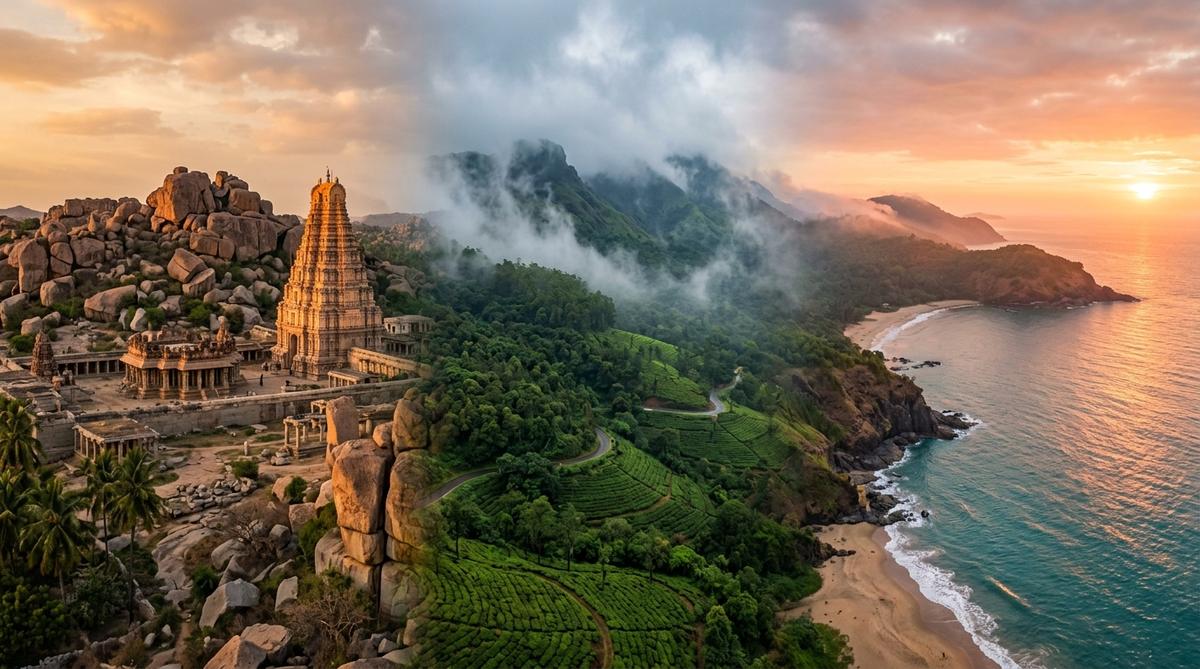
Karnataka represents one of India’s most ecologically and culturally multifaceted states. Spanning from the sun-drenched Arabian Sea coastline of Karavali to the rugged granite boulders of the Deccan Plateau and the mist-laden canopy of the Western Ghats, the state encapsulates millennia of dynastic history, pioneering biodiversity reserves, and sophisticated temple architecture.
Planning an expedition across Karnataka requires an appreciation of its distinct geographic zones, seasonal climatic rhythms, and expansive transport corridors. Known colloquially as ‘One State, Many Worlds’, Karnataka seamlessly balances ancient stone marvels with cosmopolitan urban centers, aromatic coffee plantations, pristine tropical beaches, and dense tiger reserves. For international voyagers and domestic heritage seekers alike, navigating this southern wonderland demands an analytical approach to logistics, regional cuisines, regional etiquette, and cultural preservation.
Geographical Diversity: Deccan Plateau, Malnad Highlands, and Karavali Coast
To conceptualize Karnataka’s travel topography, one must delineate the state into its three foundational physiographic divisions: Karavali, Malnad, and the Bayaluseeme. Each territorial zone possesses distinct meteorological conditions, culinary signatures, dialectal nuances, and historical developments.
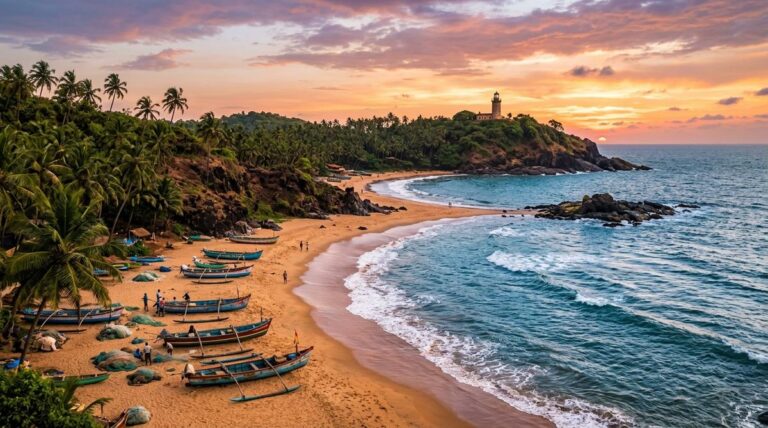
Karavali (The Coastal Strip): Wedged between the steep slopes of the Western Ghats and the Arabian Sea, this three-hundred-kilometer littoral belt encompasses the districts of Dakshina Kannada, Udupi, and Uttara Kannada. It is a land characterized by estuarine mangroves, golden sand shorelines, sacred coastal pilgrimage shrines, and thriving port settlements. The maritime climate remains warm and humid throughout the year, with torrential monsoon downpours arriving between June and September.
Malnad (The Hill Country): Translating literally to ‘the land of rain and mountains’, the Malnad region hugs the eastern and western slopes of the Sahyadri range. Encompassing districts such as Kodagu (Coorg), Chikmagalur, Hassan, and Shimoga, Malnad features dramatic altitudes ranging from six hundred to nearly two thousand meters above sea level. This mountainous spine is globally acknowledged as one of the world’s eight hottest biodiversity hotspots, cloaked in evergreen rainforests, rolling tea estates, cardamom groves, and dense shade-grown coffee plantations.
Bayaluseeme (The Open Plains): Stretching across the expansive Deccan Plateau, Bayaluseeme represents the agricultural and historical heartland of historic empires. It is subdivided into the Northern Plains (Uttara Bayaluseeme), characterized by black cotton soil, arid semi-desert scrub, rocky boulder outcrops, and monumental medieval capitals such as Hampi, Badami, and Bijapur, and the Southern Plains (Dakshina Bayaluseeme), marked by red loamy soils, silk weaving clusters, and the historic royal seat of Mysore.
Comprehensive Climate Patterns and Optimal Travel Windows
Traveling comfortably across Karnataka depends largely on aligning one’s itinerary with the local monsoon and temperature cycles. The tropical savannah climate of the plateau contrasts sharply with the humid coastal belt and the temperate mountain plateaus. Analyzing the state’s three primary meteorological seasons reveals distinct opportunities for various travel pursuits:
- The Winter Season (October through February): Universally acknowledged as the premier window for exploring Karnataka. Temperatures across the Deccan Plateau hover between fifteen and twenty-eight degrees Celsius, making open-air architectural explorations at Hampi, Pattadakal, and Chitradurga exceptionally pleasant. In the Malnad hill stations of Coorg and Chikmagalur, crisp morning chills and mist-shrouded valleys provide ideal conditions for plantation treks.
- The Pre-Monsoon Summer (March through May): Daytime temperatures in northern Karnataka can exceed forty degrees Celsius, rendering boulder climbs challenging. However, this period offers supreme advantages for wildlife photography in Nagarhole and Bandipur National Parks, as receding waterholes compel elephants, tigers, and leopards to congregate along riverbanks and watering reservoirs.
- The Southwest Monsoon (June through September): The Western Ghats receive ferocious precipitation, often exceeding four thousand millimeters in localized pockets such as Agumbe. While extensive trekking trails are closed due to active leeches and swollen rivers, the monsoon transforms the landscape into an emerald paradise. Waterfalls like Jog, Magod, and Unchalli surge with thundering volume, drawing nature lovers and landscape photographers.
| Region / Belt | Primary Districts | Landscape Character | Signature Attractions | Peak Visiting Season |
|---|---|---|---|---|
| Karavali Coastal Strip | Mangalore, Udupi, Karwar | Beaches, estuaries, fishing harbors | Gokarna, Murudeshwar, St. Mary’s Island | November to February |
| Malnad Hill Country | Kodagu, Chikmagalur, Shimoga | Cloud forests, coffee estates, waterfalls | Mullayanagiri, Abbey Falls, Kudremukh | September to March |
| Northern Bayaluseeme | Bellary, Bagalkot, Vijayapura | Granite hills, arid scrub, river valleys | Hampi, Badami Caves, Gol Gumbaz | October to February |
| Southern Bayaluseeme | Bengaluru, Mysuru, Mandya | Rolling plateaus, royal palaces, silk mills | Mysore Palace, Srirangapatna, Ranganathittu | Year-Round (Best in Autumn) |
The Golden Heritage Circuit: From Vijayanagara Splendor to Chalukyan Origins
Karnataka’s built heritage spans over fifteen hundred years of continuous architectural experimentation, religious syncretism, and royal patronages. For the culturally inclined explorer, traversing the heritage circuit provides an evolutionary chronicle of Indian temple geometry and urban defense systems.
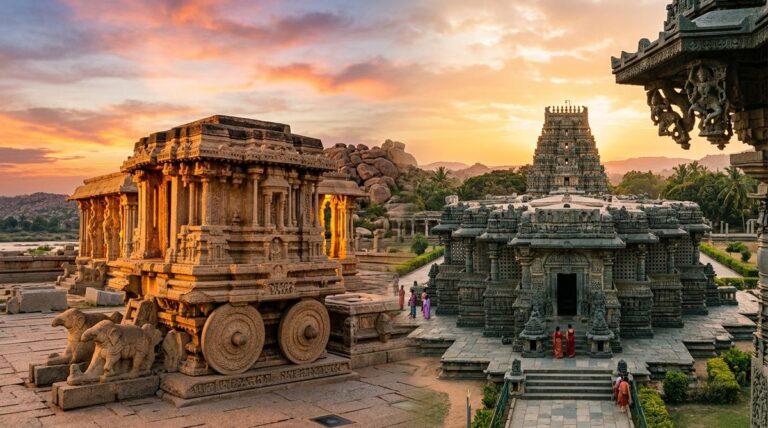
The journey fundamentally begins at Hampi, the fourteen-century capital of the Vijayanagara Empire situated along the rugged banks of the Tungabhadra River. Designated a UNESCO World Heritage site, Hampi covers over forty square kilometers of scattered ruins. Here, one discovers the monumental Virupaksha Temple, which has witnessed uninterrupted worship since the seventh century, the iconic Stone Chariot within the Vijaya Vittala temple complex, and sophisticated civil structures such as the Lotus Mahal, Elephant Stables, and step-wells that showcase advanced hydraulic engineering.
Venturing further northwest brings the voyager to the Malaprabha River Valley, where the Early Chalukyas forged the architectural grammar of South India between the sixth and eighth centuries. At Badami (ancient Vatapi), four magnificent rock-cut cave temples carved directly into red sandstone cliffs showcase breathtaking bas-reliefs of Nataraja, Vishnu as Varaha, and Jain Tirthankaras. Nearby Aihole serves as an open-air laboratory of Indian architecture, boasting over one hundred and twenty structural temples ranging from the apsidal Durga Temple to archaic rock sanctuaries. At Pattadakal, another UNESCO World Heritage site, northern Rekha-Nagara and southern Dravida shikhara styles stand harmoniously within a single sacred enclave, illustrating royal coronation rituals and artistic syncretism.
The Intricate Soapstone Ensembles of the Hoysalas
Further south in the fertile plains of Hassan district lie the architectural wonders of the Hoysala Empire at Belur, Halebidu, and Somanathapura. Recently inscribed collectively as UNESCO World Heritage sites, these eleventh-to-fourteenth-century temples diverged dramatically from earlier sandstone and granite traditions by utilizing chloritic schist, commonly known as soapstone. This soft, fine-grained metamorphic rock allowed Hoysala sculptors to achieve unbelievable levels of filigree-like precision.
At the Chennakeshava Temple in Belur, intricate star-shaped (stellate) ground plans elevate the sanctum on broad circumambulatory platforms. The exterior friezes feature continuous horizontal bands populated by hundreds of charging war elephants, roaring lions, celestial horsemen, floral scrolls, and epic scenes from the Ramayana and Mahabharata. Suspended beneath the eaves are the renowned Madanikas (bracket figures)—celestial dancers sculpted with anatomical exuberance, holding musical instruments, mirrors, and bows with miniature ornaments carved in three-dimensional undercut relief.
📐 Architectural Insight: The Stellate Plan
Hoysala master architects introduced the star-shaped platform (stellate design) by rotating square plans around a central axis. This geometric innovation significantly increased the exterior wall surface area, providing sculptors with an expansive structural canvas to chisel intricate narrative friezes without expanding the temple’s internal footprint.
The Western Ghats Eco-Corridor: Coffee Highlands, Treks, and Sanctuaries
Separating the coast from the plateau, the Western Ghats form an unbroken ecological barrier that captures the monsoon clouds and nurtures phenomenal life forms. For nature seekers and active adventurers, Karnataka’s mountain districts provide a diverse tapestry of high-altitude grasslands (Shola forests), deep evergreen ravines, and historic trekking trails.
Kodagu (Coorg): Renowned globally as the ‘Scotland of India’, Coorg is an autonomous cultural sphere inhabited by the martial and agrarian Kodava community. The landscape is dominated by dense canopies of silver oak, wild fig, and rosewood trees sheltering shade-grown Arabica and Robusta coffee plantations intertwined with climbing black pepper vines. Travelers can summit Tadiandamol, the highest peak in the district, visit the sacred source of the Cauvery River at Talakaveri, and experience community homestays that offer immersive cultural interactions.
Chikmagalur: The historical cradle of Indian coffee, Chikmagalur holds deep agrarian lore. It was on the slopes of the Bababudan Giri range in the seventeenth century that Sufi saint Baba Budan allegedly planted seven raw coffee beans smuggled from Yemen. Today, the district beckons mountain lovers to ascend Mullayanagiri, Karnataka’s highest summit rising to one thousand nine hundred and thirty meters. The hike rewards adventurers with sweeping vistas of cloud-covered valleys, rolling montane meadows, and refreshing alpine winds.
Wildlife Sanctuaries: The Heart of the Nilgiri Biosphere Reserve
Karnataka boasts one of the healthiest wild tiger, Asiatic elephant, and Indian leopard populations on the planet. The state’s protected forest matrix forms a vital link within the larger Nilgiri Biosphere Reserve, allowing unobstructed genetic flow across national parks:
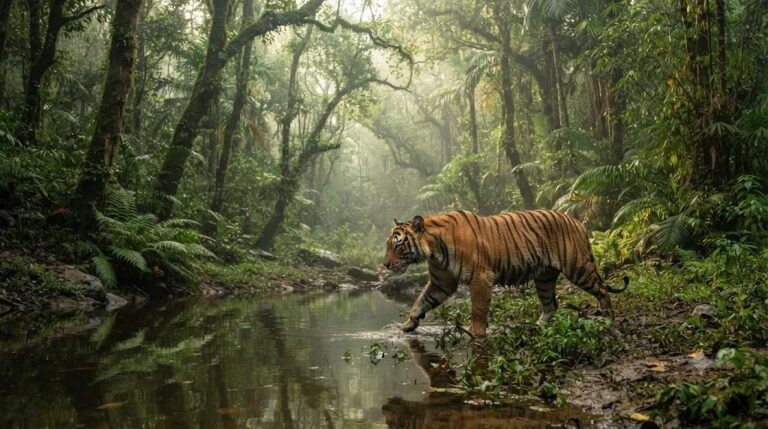
- Nagarhole National Park (Rajiv Gandhi National Park): Bordering the Kabini River, Nagarhole is celebrated worldwide for its dramatic wildlife sightings. Open safari vehicles and boat safaris routinely encounter large herds of Asian elephants swimming across backwaters, elusive melanistic leopards (black panthers), dholes (wild dogs), marsh crocodiles, and royal Bengal tigers stalking chital deer along the riverbanks.
- Bandipur National Park: Once the private hunting grounds of the Maharajas of Mysore, Bandipur forms a critical tiger conservation bastion contiguous with Tamil Nadu’s Mudumalai and Kerala’s Wayanad reserves. Dominated by dry deciduous scrub, rosewood, and sandalwood forests, it supports majestic gaur (Indian bison), sambar, sloth bears, and over two hundred species of birds.
- Kudremukh National Park: Characterized by dramatic horse-face-shaped ridges and pristine Shola grasslands, this tropical rainforest sanctuary protects endangered lion-tailed macaques, Malabar giant squirrels, and rare orchids while feeding vital westward-flowing rivers.
The Karavali Coastline: Golden Sands, Sacred Harbors, and Karavali Gastronomy
The three-hundred-kilometer coastline of Karnataka offers an authentic, serene alternative to overly commercialized beach circuits found elsewhere in the subcontinent. Dotted with ancient ports where Roman, Arab, and Portuguese traders once bartered for Malabar black pepper and cardamom, Karavali maintains an alluring balance between spiritual devotion and coastal leisure.
At Gokarna, rustic granite headlands plunge dramatically into the Arabian Sea, sequestering pristine crescent beaches named Om Beach, Kudle Beach, Half Moon Beach, and Paradise Beach. Gokarna simultaneously functions as a premier Shaivite pilgrimage destination anchored around the ancient Mahabaleshwar Temple, which houses the venerable Atmalinga. Further south, Murudeshwar features a towering hundred-and-twenty-foot seated bronze-colored statue of Lord Shiva perched atop Kanduka Hill, surrounded on three sides by crashing ocean waves.
The Epicurean Journey: Coastal and Regional Flavors
Karnataka’s gastronomy is exceptionally diverse, reflecting the geographical bounty and agricultural harvests of each distinct ecozone. A journey through the state is fundamentally incomplete without savoring its localized culinary traditions:
- Udupi Vegetarian Cuisine: Originating in the sacred kitchens of the thirteenth-century Udupi Sri Krishna Matha, this culinary school is founded on strict Satvik principles, eschewing onions and garlic while mastering complex balances of lentils, grated coconut, jaggery, curry leaves, and regional gourds. Signature dishes include authentic Bisi Bele Bath, delicate Neer Dosa, and crispy Mangalore Buns made with fermented banana dough.
- Mangalorean Coastal Specialties: Heavily influenced by coastal Bunts, Mogaveeras, and Mangalorean Catholics, this cuisine revels in maritime harvests. Fresh mackerel, seer fish, and mud crabs are simmered in fiery red chili pastes ground with roasted coriander, cumin, tamarind, and coconut milk, yielding the legendary Kori Rotti (crisp rice wafers soaked in chicken curry) and Kane Rawa Fry.
- Kodava (Coorg) Delicacies: Renowned for its bold, rustic flavors, Coorg cuisine prominently features Pandi Curry—succulent pork braised in roasted spices and darkened with Kachampuli, a pungent vinegar extracted from indigenous Garcinia gummi-gutta fruits, accompanied by steamed rice dumplings called Kadambuttu.
- North Karnataka Jolada Roti Oota: The arid northern plains rely on hardy millets. A traditional meal revolves around unleavened sorghum flatbreads (Jolada Roti) paired with spicy eggplant curry (Ennegayi), powdered pulses (Shenga Chutney Pudi), fresh spring onions, and thick churned curd.
🙏 Travel Tip: Respecting Sacred Dress Codes
When visiting functional heritage temples such as Kollur Mookambika, Gokarna Mahabaleshwar, or Udupi Sri Krishna Matha, strict traditional dress codes are strictly observed. Male devotees are required to remove upper garments (shirts/vests) and wear traditional dhotis, while female devotees should wear sarees or modest salwar kameez.
Practical Travel Logistics, Transportation, and Etiquette
Organizing a frictionless transit itinerary across Karnataka is facilitated by well-developed highway networks, railway connections, and regional aviation gateways. Understanding the transit hierarchy ensures optimal time management across vast geographical distances.
Aviation Hubs: Kempegowda International Airport (BLR) in Bengaluru functions as South India’s premier international gateway, offering round-the-clock global connectivity and direct domestic flights to regional airports in Mangaluru (IXE), Belagavi (IXG), Hubballi (HBX), and Mysuru (MYQ). Utilizing domestic hops between Bengaluru and Hubballi or Belagavi drastically reduces overland transit time when accessing northern heritage clusters like Badami and Hampi.
Railways and Highways: Indian Railways operates efficient express and superfast trains across the state. The Vande Bharat Express connects Bengaluru with Mysuru, Hubballi, and Dharwad in record time. For road voyages, the Karnataka State Road Transport Corporation (KSRTC) runs premium multi-axle Airavat and Ambari Dream Class bus fleets connecting remote taluks with urban centers. Travelers opting for self-drive or hired vehicles will find National Highways 48, 66, and 75 well-paved, though navigating the hair-raising ghat roads (Charmadi, Shiradi, and Agumbe ghats) requires cautious daylight driving.
Cultural Etiquette and Environmental Responsibility: Karnataka is celebrated for its warm hospitality. Learning basic Kannada conversational greetings such as ‘Namaskara’ (Greetings), ‘Dhanyavadagalu’ (Thank you), and ‘Dayavittu’ (Please) immediately bridges cultural divides. In ecological reserves and plantation highlands, strictly adhere to zero-plastic protocols, avoid playing loud music during forest transits, and support local community-owned homestays to foster sustainable eco-tourism.
In conclusion, Karnataka stands as a monumental microcosm of South Asia’s natural and historical wonders. From the serene morning chants echoing across the Tungabhadra River at Hampi to the golden sunset crashing over Gokarna’s rocky headlands and the deep rustle of dry leaves announcing a tiger’s presence in Nagarhole, the state offers endless discoveries for the observant and curious voyager.