👑 Pan-Indian Empire: The Colossus of Manyakheta
Between the eighth and tenth centuries CE, the Rashtrakuta Empire reigned as one of the four great empires of the medieval world, standing shoulder-to-shoulder with the Abbasid Caliphate of Baghdad, the Byzantine Empire of Constantinople, and the Tang Dynasty of China. Originating in the heart of Karnataka and ruling from their imperial capital at Manyakheta (modern Malkhed), the Rashtrakutas expanded their sovereign authority from Cape Comorin to the Himalayas, patronized the immortal Kailasa Temple at Ellora, and sponsored the birth of classical Kannada literature.
In the vast sweep of Indian geopolitical history, few dynasties ever achieved the sweeping continental dominance commanded by the Rashtrakutas of Manyakheta. Rising to prominence in 753 CE under the daring leadership of Dantidurga, who overthrew the Badami Chalukyas, the Rashtrakutas transformed Karnataka from a regional Deccan kingdom into an all-India imperial colossus. For over two centuries, Rashtrakuta armies marched victoriously into the Gangetic plains, captured the imperial city of Kannauj, dictated succession in northern kingdoms, and subdued the southern Tamil monarchies of the Cholas and Pandyas.
The Rise of Dantidurga and the Tripartite Struggle
The foundation of Rashtrakuta imperial supremacy was forged by Dantidurga (reigned 735–756 CE). Originally a feudatory governor under the Chalukyas, Dantidurga capitalized on internal Chalukyan succession crises to consolidate a formidable military coalition. In a series of lightning campaigns, he subdued the Gurjaras of Malwa, conquered the Konkan coast, defeated the Chalukyan sovereign Kirtivarman II, and performed the prestigious Hiranyagarbha (Golden Womb) imperial coronation ritual at Ujjain, proclaiming himself Maharajadhiraja (King of Kings).
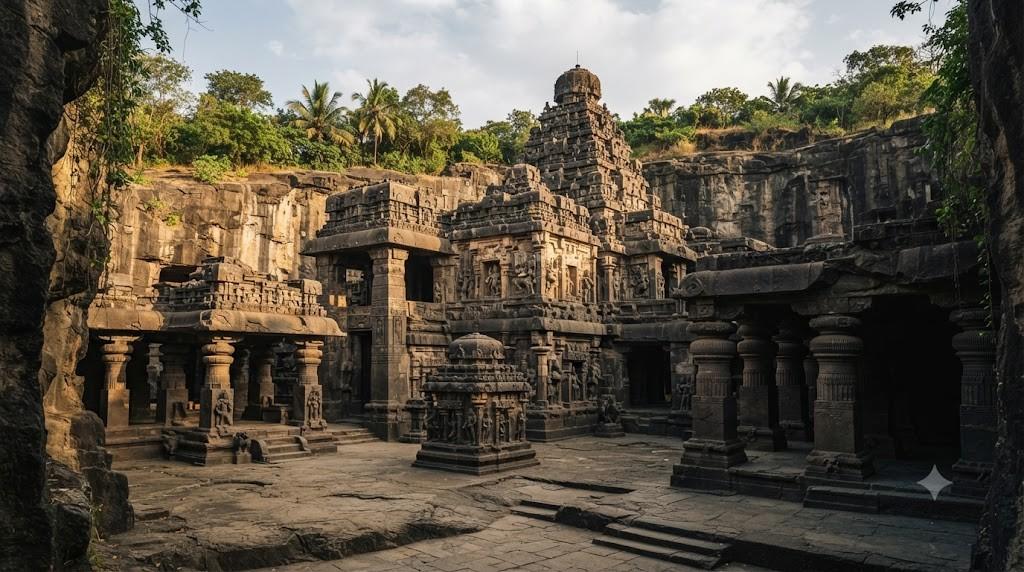
Under Dantidurga’s uncle and successor, Krishna I (reigned 756–774 CE), the empire consolidated its Deccan core. It was Krishna I who commissioned the world’s most astonishing monolithic rock-cut monument—the monumental Kailasa Temple at Ellora (Cave 16). Chiseling downward from the summit of a vertical basalt cliff, Rashtrakuta stonecutters excavated over two hundred thousand tons of volcanic rock to carve a fully freestanding, double-storied Dravidian temple complex complete with life-sized monolithic elephants, soaring victory pillars, and panoramic mythological friezes.
The Tripartite Struggle for Kannauj
Under monarchs Govinda III (reigned 793–814 CE) and Indra III (reigned 914–929 CE), the Rashtrakutas engaged in the legendary Tripartite Struggle against the Gurjara-Pratiharas of western India and the Palas of Bengal for supreme control over the imperial Gangetic capital of Kannauj. Historical inscriptions record that King Govinda III led a victorious expedition northward, receiving the submission of King Dharmapala of Bengal and holding imperial durbars on the banks of the sacred Ganges and Yamuna rivers before his horses drank from the Himalayan streams.
| Rashtrakuta Sovereign | Reign Span | Key Military Campaigns | Cultural / Literary Achievements | Historical Distinction |
|---|---|---|---|---|
| Dantidurga | 735–756 CE | Overthrow of Badami Chalukyas, Malwa conquest | Performed Hiranyagarbha imperial sacrifice at Ujjain | Founder of imperial Rashtrakuta sovereignty |
| Krishna I | 756–774 CE | Consolidation of Konkan, defeat of Western Gangas | Commissioned the Kailasa monolithic temple at Ellora | Immortalized in stone engineering history |
| Govinda III | 793–814 CE | Tripartite conquest of Kannauj, northern submission | Subdued Tamil Cholas and Cheras in the deep south | Regarded as one of India’s greatest military commanders |
| Amoghavarsha I (Nrupatunga) | 814–878 CE | Defensive consolidation, peace treaties with Gangas | Authored Kavirajamarga, built capital Manyakheta | Longest reigning monarch (64 years), philosopher-king |
| Indra III | 914–929 CE | Sacked Kannauj (916 CE), defeated Mahipala Pratihara | Patronized Jain scholar Sri Ponna and court poet Trivikrama | Reaffirmed Rashtrakuta pan-Indian hegemony |
Amoghavarsha I Nrupatunga: The Ashoka of South India
While monarchs like Govinda III represented the martial sword of the empire, the sixty-four-year reign of Amoghavarsha I (reigned 814–878 CE) represented its spiritual, literary, and cultural soul. Ascending the throne as a young prince, Amoghavarsha ruled with remarkable wisdom, prioritizing diplomacy, religious tolerance, and philosophical pursuit over aggressive territorial warfare, earning him frequent comparisons by modern historians to Emperor Ashoka.
Amoghavarsha founded the magnificent imperial capital of Manyakheta (modern Malkhed in Kalaburagi district), designing it with vast public squares, reflective pleasure tanks, and stone palaces. Contemporary Arab traveler Sulaiman al-Tajir, visiting Manyakheta in 851 CE, documented that the Rashtrakuta ruler was universally acknowledged as one of the four great emperors of the world, noting that no other sovereign in India was as revered by his subjects or maintained such peaceful, prosperous borders.
The Birth of Classical Kannada Literature: Kavirajamarga
The reign of Amoghavarsha I marks the definitive watershed in the history of the Kannada language. It was under his direct patronage (and co-authorship with court poet Sri Vijaya) that the landmark text Kavirajamarga (‘The Royal Path of Poets’) was composed around 850 CE. Kavirajamarga is the earliest surviving literary work on Kannada rhetoric, poetics, and grammar.
In this celebrated work, the author defined the geographical and cultural boundaries of the ancient Kannada-speaking world with patriotic eloquence, stating that the land of Kannada stretches from the Kaveri River in the south to the Godavari River in the north (Kaveriyindam a Godavarivaram irda naadadu). Furthermore, the text famously praised the aesthetic and intellectual sophistication of the Kannada people, describing them as ‘naturally skilled in poetic eloquence and discerning in art, even without formal academic schooling’ (Padanaridudum nudiye kavya prayogaparar).
📖 Literary Milestone: The Three Gems of Kannada Literature
The Rashtrakuta cultural renaissance set the stage for the golden age of classical Old Kannada poetry, crowned by the ‘Three Gems’ (Ratnatraya): Adikavi Pampa (author of Vikramarjuna Vijaya and Adipurana), Sri Ponna (author of Santipurana), and later Ranna. Pampa’s masterworks established the Champu style—a harmonious alternation of prose and verse—that defined Kannada literature for centuries.
Cosmopolitan Trade, Religious Tolerance, and Arab Relations
The Rashtrakuta Empire was fundamentally characterized by its sophisticated cosmopolitanism and deep religious ecumenism. Although the ruling dynasty traced its spiritual lineage to traditional Vedic Shaivism and Vaishnavism, many of its greatest sovereigns—including Amoghavarsha I and Indra III—were devout adherents and generous patrons of Jainism.
The revered Jain preceptor Acharya Jinasena, author of the Adipurana and Mahapurana, served as Amoghavarsha’s supreme spiritual preceptor and personal counselor. Brilliant Jain mathematical treatises, such as Mahaviracharya’s Ganita Sara Sangraha (the first major Indian mathematical text dedicated exclusively to arithmetic and algebra without astrological mixing), were composed under royal Rashtrakuta sponsorship at Manyakheta.
Maritime Commerce and Arab Trading Settlements
Recognizing the immense economic value of international maritime commerce, the Rashtrakutas cultivated close diplomatic and trade alliances with the Abbasid Caliphate of Baghdad. Major coastal ports in northern Karnataka and the Konkan—such as Sanjan, Chaul, and Honnavar—flourished as multinational trading hubs.
In an era of remarkable religious tolerance, Rashtrakuta monarchs granted Arab Muslim merchants (known in Kannada inscriptions as Hanjamana guilds) extensive civil charters to establish permanent trading settlements along the coast. Inscriptions at Sanjan record that the Rashtrakuta administration formally appointed an Arab merchant named Muhammad Sugatpar as the municipal governor of the district, granted land endowments to construct coastal mosques (masjids), and permitted Muslim communities to resolve civil disputes according to Islamic jurisprudence. In exchange, Arab merchants supplied the imperial cavalry with tens of thousands of premium Arabian war horses, which were critical for campaigns in northern India.
| Domain / Aspect | Rashtrakuta Institutional Innovation | Historical Impact & Legacy |
|---|---|---|
| Imperial Geopolitics | Tripartite domination of Kannauj & Ganges-Yamuna basin | Proved Deccan empires could dictate sovereign terms across northern India |
| Literature & Language | Kavirajamarga (c. 850 CE) and patronage of Adikavi Pampa | Codified classical Old Kannada grammar, poetics, and defined regional identity |
| Rock-Cut Engineering | Kailasa Temple at Ellora (Cave 16) under Krishna I | World’s largest monolithic downward excavation, pinnacle of rock stonecraft |
| Religious Coexistence | Simultaneous state patronage of Shaivism, Vaishnavism, and Jainism | Created a culture of intellectual debate, mathematical inquiry, and Ahimsa |
| International Trade | Diplomatic and commercial treaties with Abbasid Caliphate | Established thriving Arab horse trade ports and multi-faith merchant guilds |
The Architectural Legacy: From Manyakheta to Ellora and Shiraval
While the monolithic Kailasa Temple at Ellora (situated in modern Maharashtra, then part of core Rashtrakuta territory) remains the dynasty’s most famous monument, their architectural footprint within Karnataka is rich with refined stone structural temples:
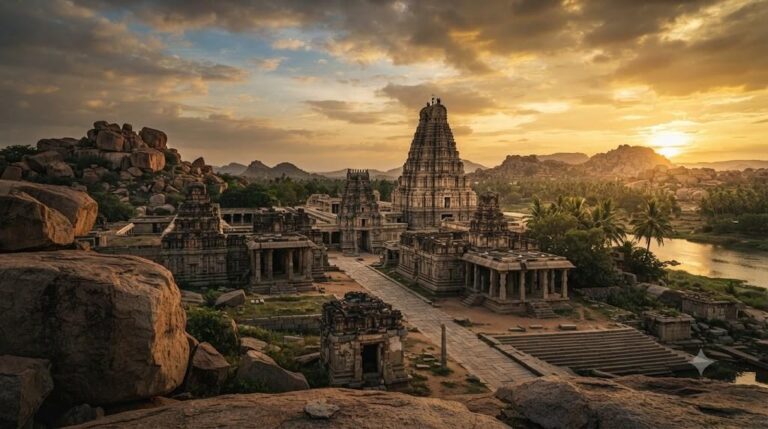
- The Monuments of Malkhed (Manyakheta): Although much of the medieval brick palaces were dismantled during subsequent Bahmani and Mughal wars, the modern village of Malkhed preserves the formidable ruins of Malkhed Fort along the Kagini River, ancient Jain shrines, and the sacred Vrindavana of the celebrated Dvaita philosopher Jayatirtha.
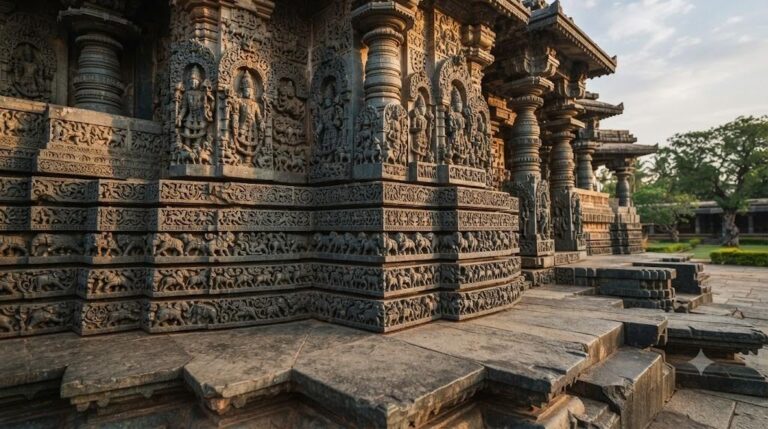
- The Temple Cluster of Shiraval (Sannati Basin): Located in Kalaburagi district along the Bhima River, Shiraval preserves a remarkable cluster of twelve structural sandstone temples built in the late ninth and tenth centuries. Structures like the Siddheshwara and Mallikarjuna temples feature stepped pyramidal Dravidian towers, open pillared halls, and intricately chiseled ceiling panels depicting the guardians of the eight directions (Ashtadikpalas).
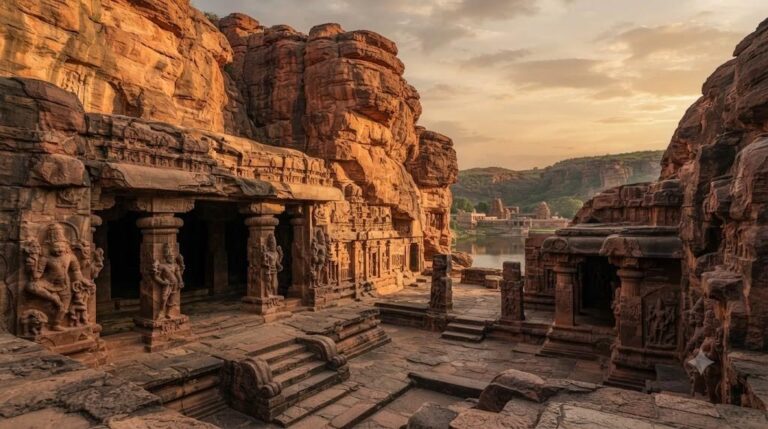
- The Jain Narayana Temple at Pattadakal: Built in the ninth century, likely during the reign of Amoghavarsha I or Krishna II, this temple is the sole major Jain structural sanctuary within the UNESCO World Heritage complex at Pattadakal. It features a triple-storied Dravidian vimana tower, a spacious pillared mandapa, and colossal seated stone Tirthankara icons flanked by celestial flywhisk bearers.
The Sunset of Imperial Dominance and Historical Memory
The extraordinary hegemony of the Rashtrakutas concluded in 973 CE. Weakened by continuous wars against the emerging Paramaras of Malwa and the revived imperial Cholas of Thanjavur, the last sovereign, Karka II, was overthrown by his ambitious feudatory general Tailapa II, who re-established the Western Chalukya dynasty of Kalyana.
Yet, two centuries of Rashtrakuta rule permanently reshaped the cultural DNA of South Asia. They demonstrated that a Deccan power rooted in Karnataka could project imperial power across the entire Indian subcontinent; they gave the Kannada language its classical literary constitution; they provided safe harbor for pioneering Arab merchants; and they chiseled into the living rock of Ellora a monument that continues to fill all of humanity with awe. The legacy of Manyakheta remains one of the proudest chapters in the epic story of Indian civilization.
The Engineering Miracle: Excavating the Kailasa Temple at Ellora
To fully comprehend the sheer civilizational audacity of the Rashtrakuta Empire, one must examine the extraordinary structural engineering techniques deployed under King Krishna I to create the Kailasa Temple at Ellora (Cave 16). Unlike every other major temple in India—which was constructed by assembling pre-cut stone blocks—the Kailasa temple was created entirely by subtractive excavation.
Rashtrakuta master masons began at the top of a vertical basalt cliff, marking out the rectangular perimeter of the temple complex. Working downward with hand chisels, iron hammers, and pickaxes, teams of quarrymen excavated two parallel trenches ninety meters deep into the mountain, isolating a massive central monolith of solid volcanic rock. From this freestanding stone block, sculptors meticulously carved a two-story temple complex measuring thirty meters high, hollowed out interior sanctums, carved life-sized freestanding elephants, erected thirty-meter victory pillars (dhwaja-stambhas), and sculpted thousands of square meters of intricate mythological reliefs. An estimated two hundred thousand to four hundred thousand tons of basalt rock were removed over several decades, leaving behind a structural masterpiece that has no equal in the history of human architecture.
The Cosmopolitan Court at Manyakheta and International Alliances
The capital city of Manyakheta was not merely an administrative fort; it was a flourishing intellectual and economic metropolis that welcomed foreign scholars, traders, and diplomats. Arab chronicler Al-Masudi, writing in the early tenth century, noted that the sovereign of Manyakheta—whom the Arabs called the Balhara (a transliteration of the imperial title Vallabharaja)—was universally considered the greatest king in India, maintaining vast standing armies, patronizing international commerce, and according complete freedom of worship to merchants of all nations.
📜 Linguistic Evolution: Halegannada and the Inscriptional Legacy
The Rashtrakuta era crystallized the transition of Old Kannada (Halegannada) into a sophisticated vehicle for philosophical inquiry, courtly administrative jurisprudence, and epic poetic narrative. Stone inscriptions from this period demonstrate a seamless blending of Dravidian linguistic roots with Sanskrit literary idioms, laying the foundation for modern Kannada literature.
Provincial Administration, Currency Systems, and Numismatic Heritage
The institutional stability of the Rashtrakuta Empire over two centuries was reinforced by an exceptionally sophisticated administrative hierarchy and a standardized currency system that facilitated international and domestic trade across South Asia.
The empire was systematically partitioned into primary administrative divisions termed Rashtras (provinces), overseen by royal governors styled as Rashtrapatis. These were further subdivided into Vishayas (districts) governed by Vishayapatis, and local rural administrative circles termed Bhuktis, which coordinated groups of fifty to a hundred villages under the supervision of hereditary village headmen known as Gramakutas. Inscriptions indicate that village assemblies enjoyed substantial autonomy, managing community irrigation tanks, collecting agricultural taxes in grain, and adjudicating civil property boundaries through local councils.
In the realm of numismatics, the Rashtrakutas minted high-purity gold and silver coinage—frequently termed Drammas and Gadyanas in inscriptional records. These coins featured royal emblems including the divine eagle Garuda (the celestial mount of Vishnu), the trident of Shiva, and royal titles in early Kannada and Nagari scripts. These standardized coins circulated widely through trade routes from the ports of Karwar and Chaul across the Arabian Sea to the markets of Baghdad, Cairo, and Damascus, underscoring the formidable economic integration achieved by the masters of Manyakheta.