✨ The Crown Jewel of Hoysala Stonecraft: Filigree in Chloritic Schist
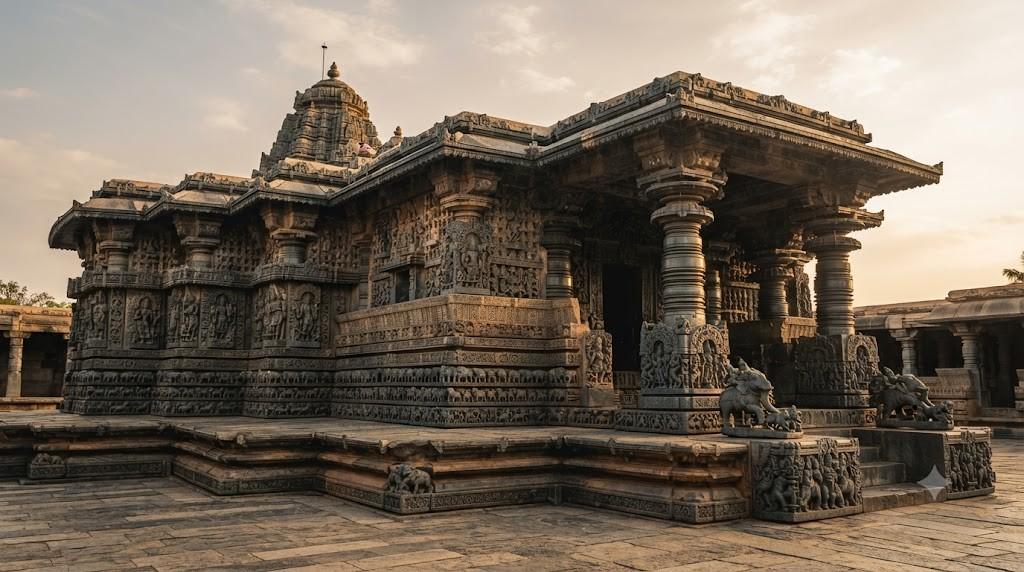
Standing proudly on the banks of the Yagachi River in Hassan district, the Chennakeshava Temple at Belur represents the absolute summit of medieval South Indian soapstone sculpture. Commissioned in 1117 CE by King Vishnuvardhana to commemorate his epochal military victory at Talakadu, the temple required one hundred and three years of continuous labor by three generations of master artisans. Renowned for its thirty-eight exquisite bracket Madanika sculptures, lathe-turned monolithic columns, and signed artist panels, Belur stands as an immortal monument of stone poetry.
In the vast pantheon of Indian temple architecture, the Chennakeshava Temple at Belur occupies an exalted, solitary pinnacle. While earlier dynasties chiseled granite boulders or coarse sandstone blocks, the master sculptors of the Hoysala court discovered the astonishing aesthetic possibilities of chloritic schist (soapstone). With this pliant, velvety stone, they transformed traditional religious sanctuaries into breathtaking jewelry-boxes of three-dimensional stone lace, achieving levels of undercut precision, anatomical grace, and expressive dynamism that have no parallel in world art.
Historical Context: King Vishnuvardhana and the Talakadu Victory
The historical genesis of Belur is deeply rooted in the geopolitical and religious transformations of twelfth-century Karnataka. In 1116 CE, King Bittideva—the ambitious sovereign of the burgeoning Hoysala Empire—achieved an epochal military victory by defeating the powerful Chola imperial army at the strategic fortress of Talakadu along the Cauvery River. This triumph liberated southern Karnataka from Chola hegemony, establishing the Hoysalas as an independent sovereign empire.
Shortly before this military campaign, King Bittideva came under the profound spiritual influence of the great Vaishnavite theologian and social reformer Sri Ramanujacharya, who had fled persecution in Tamil Nadu. Inspired by Ramanujacharya’s philosophy of Vishishtadvaita (qualified non-dualism), the king formally converted from Jainism to Vaishnavism, adopting the coronation name Vishnuvardhana. To commemorate both his military emancipation and his newfound spiritual devotion, the king commissioned the grand temple of Vijayanarayana (now celebrated as Chennakeshava, meaning ‘Handsome Keshava’) at his royal capital of Belur in 1117 CE.
The Hundred-Year Architectural Odyssey
Constructing a monument of such unprecedented sculptural density was an inter-generational enterprise. Initiated under King Vishnuvardhana in 1117 CE, the project continued uninterrupted under his son Narasimha I and was finally brought to completion under his illustrious grandson Veera Ballala II in 1220 CE—spanning one hundred and three years of continuous artistic labor. Over three generations, guilds of hereditary stonecutters, architects, and polishers lived within the temple precinct, passing down specialized tools, lathe-turning techniques, and iconographic formulas from father to son.
| Architectural Element | Structural Medium | Master Sculptor / Era | Key Artistic Feature | Symbolic Significance |
|---|---|---|---|---|
| The Raised Jagati | Chloritic Schist | Early 12th Century (Vishnuvardhana) | Star-shaped elevated platform, 1.5 meters high | Circumambulatory pathway at eye-level with narrative friezes |
| Base Horizontal Friezes | Soapstone Ashlar Blocks | Guild of Balligavi (1117–1160 CE) | 8 horizontal tiers: 650 elephants, lions, horses | Symbolic foundation of strength, courage, speed, and beauty |
| 38 Bracket Madanikas | Chloritic Schist Monoliths | Dasoja, Chavana, Mallitamma | 3D undercut relief, rotating stone bangles, mirrors | Idealized celestial beauty engaged in arts and athletics |
| Lathe-Turned Pillars | Monolithic Black Schist | Master Machinists (12th Century) | Mirror-polished circular moldings, Mohini pillar | Mechanical stone-lathe triumph supporting massive ceiling |
| Central Garbhagriha | Soapstone & Gold Trim | Consecrated 1117 CE | Colossal 6-foot idol of Chennakeshava with 24 attributes | Presiding manifestation of cosmic protector Vishnu |
The Architectural Anatomy: The Stellate Jagati and Horizontal Friezes
The Chennakeshava Temple is an Ekakuta (single-shrined) temple elevated upon a wide, star-shaped stone platform known as a Jagati. Rising approximately one and a half meters above the ground, this platform serves as an open-air circumambulatory walkway (pradakshina patha). By omitting the towering compound walls and soaring entrance gopurams of traditional Tamil Dravidian temples, Hoysala architects ensured that the external walls of the temple would be fully visible to approaching devotees, bathed in natural sunlight.
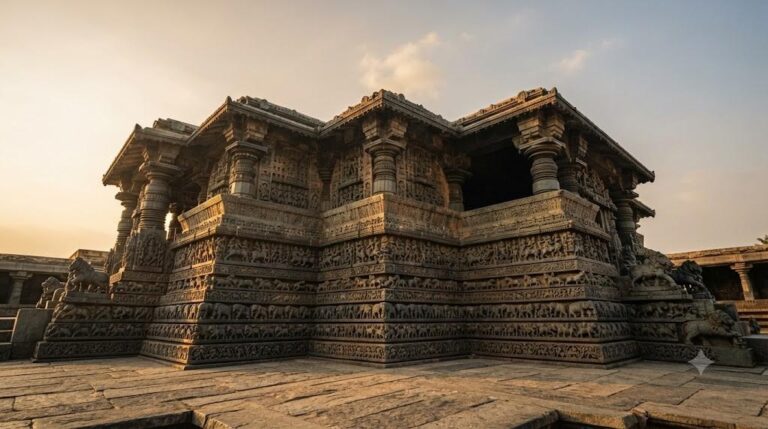
The exterior perimeter of the temple plinth is fortified by eight continuous tiers of horizontal narrative friezes, stretching around the entire circumference. Each band adheres to a strict philosophical and structural hierarchy:
- The Elephant Tier (Lowest Tier): Approximately six hundred and fifty individual elephants march in continuous procession along the base. Astonishingly, not a single elephant is identical to another. Some charge with raised trunks, others lock tusks in play, young calves shelter beneath matriarchal bellies, and warrior elephants wear detailed chain mail and protective head plates, symbolizing the foundational strength and stability of the cosmos.
- The Shardula / Lion Tier: Depicting mythological lions, symbolizing courage, imperial sovereignty, and vigilance.
- The Foliage and Creeper Tier: Intricate floral arabesques and trailing scrollwork, symbolizing natural abundance and aesthetic joy.
- The Cavalry Horse Tier: Galloping war horses ridden by caparisoned warriors, symbolizing speed, mobility, and military preparedness.
- The Epic Panels (Upper Bands): Micro-carved horizontal friezes depicting episodes from the Ramayana, Mahabharata, and Bhagavata Purana, functioning as an open-air illustrated scripture for the medieval public.
📐 Architectural Insight: The Stellate Projection
The stellate (star-shaped) footprint of the Belur temple was generated by rotating square modules around a central pivot. This geometric rotation doubled the exterior wall perimeter, providing over twice the linear surface area of a standard square temple, allowing master sculptors to chisel thousands of narrative panels without expanding the building’s physical footprint.
The Madanikas: Immortal Celestial Poetry in Undercut Stone
The supreme glory of Belur resides in the world-renowned thirty-eight bracket figures, celebrated in Indian art history as Madanikas (or Salabhanjikas). Positioned high on the exterior pillars beneath the overhanging stone eaves, each Madanika is carved from a single monolithic slab of soapstone, angled forward at forty-five degrees to support the ceiling beams while presenting an astonishing celebration of feminine grace, athleticism, and courtly arts.
The Most Celebrated Madanika Masterpieces
- Darpana Sundari (The Beauty with the Mirror): The undisputed icon of Hoysala stonecraft. A graceful woman gazes with serene self-admiration into an oval stone mirror held in her left hand, while her right hand delicately adjusts a pearl earring. The master sculptor achieved such breathtaking undercut depth that her stone armlets and wrist bangles can be gently rotated around her wrists.
- The Huntress (The Archer Maiden): An athletic tribal maiden drawing a stone bowstring, her gaze locked on distant quarry, her muscular calves clad in woven leaf sandals with miniature shoelaces meticulously chiseled into the stone.
- Mridanga Vadini (The Drummer): A celestial musician caught mid-rhythm, her fingers poised to strike a double-headed drum, her heavy braided hair swinging outward with realistic centrifugal momentum.
- The Maiden and the Scorpion: A dramatic, comic narrative sculpture depicting a young woman shaking a venomous scorpion from her slipping silk garments, her facial expression capturing a perfect balance of alarm and modesty.
- The Flautist and the Shuka Bhashini: Other bracket panels portray a maiden playing a flute whose hollow finger-holes were delicately drilled through solid stone, and a woman conversing with a pet parakeet perched on her wrist.
👑 Master Sculptor Legend: Shantala Devi’s Inspiration
According to enduring regional folklore, the expressive postures of the Belur Madanikas were directly inspired by King Vishnuvardhana’s beloved senior queen, Shantala Devi. A master of classical Sanskrit drama, music, and dance, Queen Shantala posed for the royal sculptors, immortalizing her courtly elegance in enduring soapstone.
The Interior Navaranga: Lathe-Turned Columns and the Mohini Pillar
Passing through the perforated stone lattice windows into the interior congregational hall (Navaranga) transports the visitor from bright tropical sunlight into a cool, mystical realm of stone shadows. The vast hall is supported by forty-eight central monolithic pillars, each showcasing an extraordinary mechanical achievement: the lathe-turned column.
Hoysala master machinists mounted rough-hewn soapstone cylinders onto massive horizontal mechanical lathes powered by waterwheels or draft animals. As the stone rotated at high velocity, artisans applied specialized iron chisels, producing perfectly concentric circular moldings, fluted rings, and bell-shaped capitals polished to an obsidian mirror-like sheen. When oil lamps are lit inside the hall, these polished stone pillars reflect shifting golden halos like burnished metal.
The Narasimha and Mohini Pillars
Among the interior columns, two stand out for their exceptional structural and sculptural singularity:
- The Mohini Pillar: Carved from dense dark schist, this pillar is not lathe-turned, but hand-carved with breathtaking micro-reliefs of Vishnu manifesting as the celestial enchantress Mohini, flanked by miniature friezes of the ten incarnations (Dashavatara).
- The Narasimha Pillar: Historically known as the ‘rotating pillar’, this column was engineered on a ball-and-socket joint that allowed it to rotate around its central vertical axis, symbolizing the cosmic stability of the divine protector.
| Interior Element | Location within Mandapa | Engineering / Artistic Technique | Visual / Spiritual Effect |
|---|---|---|---|
| Lathe-Turned Columns (48) | Central Navaranga Hall | Horizontal rotary lathe turning & stone buffing | Mirror-polished circular moldings reflecting lamp flames |
| Central Lotus Ceiling Dome | Navaranga Central Bay | Concentric cantilevered stone rings with hanging pendant | Illusion of an unfurling celestial lotus ascending to heaven |
| Mohini Column | South-western Mandapa bay | Hand-carved fluting with micro-deity bas-reliefs | Depicts Vishnu as cosmic enchantress distributing amrita |
| Perforated Stone Jalis (28) | Exterior window openings | Pierced soapstone screens with geometric latticework | Filters harsh daylight into cool, meditative interior glow |
| Garbhagriha Lintel (Torana) | Sanctum sanctorum entrance | Deeply undercut Makara arch framing Vishnu | Triumphant celestial gateway into the presence of Chennakeshava |
The Signed Masters: Dasoja, Chavana, and Mallitamma
One of the most extraordinary aspects of the Chennakeshava Temple is the presence of sculptor signatures. In classical Indian art, artisans almost universally remained anonymous, offering their work selflessly to the divine. Belur broke decisively with this tradition.
Proud master sculptors incised their names, ancestral villages, titles, and even playful professional challenges directly beneath their sculptures. The master craftsman Dasoja of Balligavi inscribed his name beneath four of the finest bracket Madanikas, styling himself as ‘the thunderbolt to the mountain of rival sculptors’. His gifted son, Chavana, chiseled five Madanikas, proudly signing himself as ‘the matchless creator of celestial forms’. Other signatures record the contributions of Ruvari Mallitamma, Chikka Hampa, and Malla, giving human faces, family lineages, and professional pride to the creators of this stone masterpiece.
Preservation and the UNESCO World Heritage Milestone
In September 2023, the global cultural significance of Belur was officially sanctified when UNESCO inscribed the Sacred Ensembles of the Hoysalas (uniting Belur, Halebidu, and Somanathapura) onto the World Heritage List. This long-overdue recognition confirms what art lovers have known for centuries: that the master sculptors of the Hoysala court achieved one of humanity’s greatest triumphs of artistic expression.
Today, as sunlight washes over the star-shaped platform of Belur and illuminates the delicate features of Darpana Sundari, the temple continues to evoke profound wonder. It stands not merely as an ancient house of prayer, but as an eternal anthem in stone—a testament to what human hands, guided by deep devotion and boundless artistic ambition, can achieve when they dare to chisel their dreams into the eternal rock of Karnataka.
The Iconography of the Central Sanctum: The 24 Murthis of Vishnu
While visitors are naturally dazzled by the exterior bracket Madanikas, the spiritual heart of the Chennakeshava Temple resides within the innermost sanctum (Garbhagriha). Here, elevated upon a high stone pedestal, stands the presiding deity: the majestic six-foot-tall idol of Lord Vijayanarayana (Chennakeshava).
Carved from dense, dark chlorite schist and polished to a velvety sheen, the deity is depicted standing in the classic Samabhanga (balanced upright) posture, radiating serene grace. In his four hands, Chennakeshava holds the traditional divine emblems: the discus (Chakra), the conch shell (Shankha), the lotus flower (Padma), and the mace (Gada). Framing the idol is an extraordinarily intricate stone arch (Prabhavali) depicting the twenty-four canonical forms of Vishnu (Chaturvimshati Murti), carved in microscopic high relief. Master jewelers and metallurgists adorned the idol with repoussé gold armor, diamond crowns, and silver sandals gifted by successive Hoysala, Vijayanagara, and Mysore Wodeyar monarchs over eight centuries of continuous devotional worship.
The Acoustic Dynamics of the Navaranga Hall
The interior congregational hall of Belur is an acoustic marvel. Because the walls are constructed of dense soapstone without mortar and punctured only by perforated stone screens (Jalis), sound waves inside the mandapa experience unique reverberation times. When classical vocalists chant Vedic mantras or temple percussionists play the traditional Maddale drum, the sound is naturally amplified and warmed by the polished curved surfaces of the lathe-turned pillars, creating an acoustic ambiance that mimics a modern recording studio.
The Annual Car Festival: Rathotsava and Living Ritual Traditions
The living cultural vitality of the Chennakeshava Temple at Belur is dramatically demonstrated during its annual Rathotsava (Car Festival), held over twelve vibrant days in the spring month of Chaitra (March–April). During this grand festival, a colossal multi-tiered wooden chariot (Brahma Ratha) standing nearly fifty feet high is hand-drawn by thousands of devotees through the historic town streets, carrying the processional brass idol of Chennakeshava adorned in heirloom diamond jewelry.
In an extraordinary tradition of communal harmony that has endured since the fourteenth century, the grand procession formally commences only after a representative from the local Muslim community of Doddameduru reads selected passages from the holy Quran from the steps of the chariot. This historic ritual, established under the inclusive guidance of Hoysala and Vijayanagara monarchs, highlights the syncretic social fabric of Karnataka, where sacred spaces foster enduring bonds of mutual respect and community harmony across diverse religious traditions.