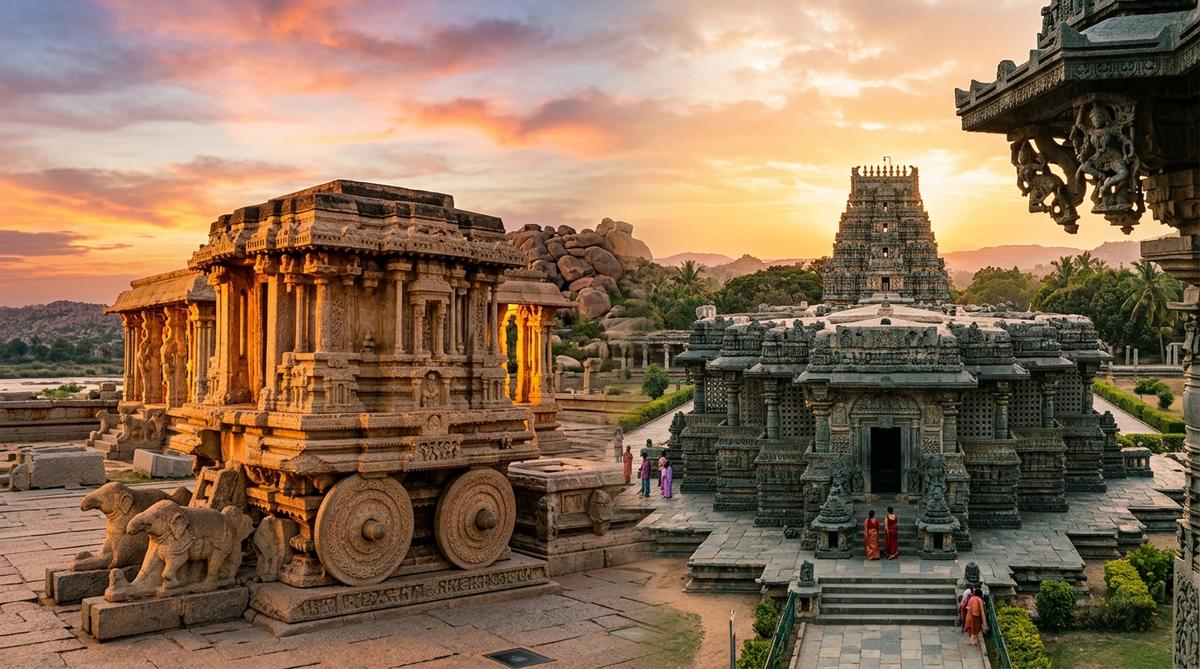
🏛️ Heritage Milestone: A Global Architectural Legacy
Karnataka boasts one of South Asia’s densest concentrations of UNESCO World Heritage-inscribed cultural monuments. From the colossal imperial capital of the Vijayanagara rulers at Hampi to the experimental seventh-century dynastic laboratories at Pattadakal and the newly inscribed Hoysala Sacred Ensembles at Belur, Halebidu, and Somanathapura, the state stands as a living museum of Indian stone engineering.
For architectural scholars, cultural historians, and world travelers, traversing Karnataka’s UNESCO World Heritage Trail offers an extraordinary journey through centuries of dynastic ambitions, theological shifts, and artistic breakthroughs. Unlike freestanding monuments isolated from their cultural landscapes, Karnataka’s heritage sites remain deeply integrated into dynamic river basins, rocky terrains, and living pilgrimage traditions. This comprehensive treatise explores the history, architectural grammar, structural evolution, and interpretive significance of these globally celebrated monuments.
The Monumental Epic of Hampi: Imperial Splendor of Vijayanagara
Inscribed as a UNESCO World Heritage site in 1986, the Group of Monuments at Hampi encompasses over forty square kilometers along the boulder-strewn banks of the sacred Tungabhadra River in central Karnataka. Between 1336 and 1565 CE, Hampi served as the fortified seat of the Vijayanagara Empire—a cosmopolitan superpower that coordinated trade networks stretching from Portugal and Persia to the Malacca Straits.
The urban architecture of Hampi was divided into two distinct morphological zones: the Sacred Centre, anchored along the riverbanks by monumental temple complexes, and the Royal Centre, designed for imperial administration, royal residences, treasury storage, and military apparatus. The city’s master builders utilized local granite boulders to construct defensive concentric walls, stepped aqueducts, and soaring gopurams that commanded panoramic views over the Deccan wilderness.
The Vijaya Vittala Complex: Stone Chariot and Acoustic Columns
The pinnacle of late Vijayanagara stonecraft is preserved within the Vijaya Vittala Temple, dedicated to Lord Vishnu. Approached via a half-kilometer-long stone market bazaar where medieval merchants once bartered diamonds, silks, and Arabian horses, the temple complex features two world-renowned architectural wonders:
- The Iconic Stone Chariot (Garuda Shrine): Functioning as a portable shrine for Vishnu’s celestial mount Garuda, this monolithic masterpiece represents one of India’s three celebrated stone chariots (alongside Konark and Mahabalipuram). Carved from multiple slabs of granite with joints disguised beneath delicate relief moldings, the chariot rests on four rotating stone wheels adorned with floral hubs, guarded by stone elephants added during subsequent restoration periods.
- The Maha Mantapa Musical Pillars: The temple’s grand pillared hall contains fifty-six monolithic columns carved with clusters of slender vertical shafts. When tapped gently by artisans in historical antiquity, these monolithic resonating shafts emit distinct musical notes tuned to traditional Indian melodic scales (svaras). The pillars represent an acoustic and structural triumph, supporting immense cantilevered stone beams while providing musical resonance during ceremonial temple dances.
💧 Engineering Insight: Hydraulic Infrastructure of Hampi
Beyond temples, Vijayanagara engineers constructed a sophisticated hydraulic grid. Interconnected stone aqueducts transported river water across kilometers to feed public stepped baths (such as the Pushkarani), royal pleasure pavilions, and underground drainage channels, ensuring uninterrupted civic supply even during prolonged military sieges.
The Virupaksha Temple and Living Sacred Ensembles
Unlike the ceremonial monuments of Vittala, the Virupaksha Temple represents a living spiritual shrine that predates the foundation of the empire and has maintained continuous worship for over thirteen centuries. Dedicated to Lord Shiva as Virupaksha, the consort of regional goddess Pampa, the temple features an imposing fifty-meter-high eastern entrance gopuram that towers over the Hampi bazaar. Inside the sanctum, an optical pinhole camera effect projects an inverted shadow of the towering gopuram onto an interior chamber wall, illustrating early Indian practical knowledge of optics and light transmission.
Pattadakal: The Cradle of Temple Architecture and Style Harmonization
Located in Bagalkot district along the tranquil waters of the Malaprabha River, the Group of Monuments at Pattadakal was inscribed as a UNESCO World Heritage site in 1987. During the seventh and eighth centuries under the Early Chalukya dynasty, Pattadakal—originally named Pattada Kisuvolal, meaning ‘City of the Ruby Crown’—served as the sacred royal coronation site for Chalukyan sovereigns.
Pattadakal holds exceptional global value because it documents the historic cross-fertilization of two distinct classical Indian architectural idioms: the northern Nagara style (characterized by curvilinear beehive shikhara towers) and the southern Dravida style (marked by pyramidal stepped tiers crowned by a domical kalasha). Chalukya rulers invited master stonecutters from both northern kingdoms and Pallava territories in the south, encouraging mutual dialogue that resulted in harmonious stylistic integration.
| Temple Monument | Architectural Style | Sponsoring Ruler / Era | Key Sculptural Highlights | Significance in Evolution |
|---|---|---|---|---|
| Virupaksha Temple | Dravida (Southern) | Queen Lokamahadevi (740 CE) | Ramayana & Mahabharata friezes, massive Nandi hall | Modeled after Kanchipuram Kailasanatha; inspired Ellora Kailasa |
| Mallikarjuna Temple | Dravida (Southern) | Queen Trailokyamahadevi (740 CE) | Intricate Shaivite narratives, pillared mandapa | Twin monument honoring victory over Pallavas |
| Papanatha Temple | Hybrid (Vesara/Nagara) | Late Chalukyan Era (c. 735 CE) | Northern curvilinear tower with southern base friezes | Demonstrates structural experimentation between styles |
| Galaganatha Temple | Nagara (Northern) | 8th Century CE | Recessed shikhara niches, Nataraja dancing sculpture | Pure representation of northern rekha-nagara geometry |
The crown jewel of Pattadakal is the Virupaksha Temple, commissioned by Queen Lokamahadevi in 740 CE to celebrate King Vikramaditya II’s military triumphs over the Pallavas of Kanchipuram. The monument is so structurally sophisticated that Rashtrakuta conqueror Krishna I subsequently utilized it as the direct architectural template for the monumental rock-hewn Kailasa Temple at Ellora. Every square meter of the temple’s outer walls, pillared porch, and mandapa ceilings is enlivened with dynamic bas-reliefs illustrating episodes from the Panchatantra, Bhagavata Purana, and contemporary martial encounters.
The Sacred Ensembles of the Hoysalas: Belur, Halebidu, and Somanathapura
In September 2023, UNESCO inscribed the Sacred Ensembles of the Hoysalas onto the World Heritage list, formally recognizing the sublime architectural zenith achieved by the Hoysala Empire between the eleventh and fourteenth centuries. The inscription unites three exceptional temple complexes across southern Karnataka: the Chennakeshava Temple at Belur, the Hoysaleshwara Temple at Halebidu, and the Keshava Temple at Somanathapura.
Hoysala temple architecture is distinguished by three revolutionary stylistic departures from earlier Dravidian typologies:
- The Adoption of Soapstone (Chloritic Schist): While earlier dynasties chiseled intractable granite or coarse sandstone, the Hoysalas sourced soft metamorphic soapstone from regional quarries. Freshly quarried soapstone is remarkably pliant, allowing carvers to execute microscopic lace-like undercuts, hollow filigree jewelry, and translucent fingernails before the stone hardens over centuries upon exposure to the atmosphere.
- The Jagati and Stellate Plan: Hoysala temples omit the soaring entry gopurams of Tamil Nadu in favor of an elevated platform called a Jagati. The sanctums are laid out on a star-shaped (stellate) polygon, generated by rotating squares around a central pivot. This complex geometric footprint multiplies the exterior wall area, providing linear horizontal bands for continuous mythological friezes.
- Signed Master Sculptor Inscriptions: Uniquely in Indian art history, Hoysala artisans signed their masterpieces. Inscriptions preserve the proud names of master sculptors such as Ruvari Mallitamma, Dasoja, and Chavana, who recorded their parentage, hometowns, and royal titles at the base of their sculptures.
Belur Chennakeshava: The Epitome of Sculptural Dynamism
Commissioned by King Vishnuvardhana in 1117 CE to commemorate his military triumph over Chola forces at Talakadu, the Chennakeshava Temple at Belur took over a century to complete. The temple’s exterior plinth is fortified by eight continuous tiers of horizontal friezes. The lowest tier features six hundred and fifty individual elephants, each chiseled in a distinct postural gesture—some trumpeting, others locking tusks, and young calves trotting beside matriarchs.
Suspended high on the exterior pillars beneath the overhanging eaves are thirty-eight exquisite bracket sculptures known as Madanikas or Salabhanjikas. These portray feminine beauty engaged in artistic pursuits: the Darpana Sundari admiring her reflection in a mirror, the huntress drawing her bowstring, the musician playing the drum, and the dancer shaking drops of water from her hair. The precision of the undercut sculpting is so extraordinary that a fine silk thread can be threaded behind the jewelry, stone bangles, and hair strands.
Halebidu Hoysaleshwara: The Climax of Narrative Stone Relief
Located sixteen kilometers east of Belur in the ancient Hoysala capital of Dorasamudra, the Hoysaleshwara Temple at Halebidu is a twin-shrined (dvikuta) Shaivite temple of breathtaking scale. Dedicated to Hoysaleshwara and Shantaleshwara, the temple rests on a grand stellate platform guarded by colossal monolithic Nandi bulls housed in open pillared pavilions.
The exterior walls of Halebidu present an unbroken panoramic frieze over two hundred meters long, containing over two hundred and forty large-scale relief panels depicting the Hindu pantheon. Shiva dances the Tandava on the vanquished demon of ignorance; Vishnu manifests in his cosmic incarnations; and Ravana shakes Mount Kailasa with twenty muscular arms. The intricate ornamental density is so overwhelming that nineteenth-century architectural historian James Fergusson noted that ‘the human hand has never sculpted stone with such astonishing dexterity and inexhaustible variety.’
🧭 Visitor Information: Somanathapura Keshava Temple
While Belur and Halebidu lie in Hassan district, the third inscribed jewel—the Keshava Temple at Somanathapura—is situated near Mysuru. Completed in 1268 CE under general Soma, this trikuta (triple-shrined) temple is the most symmetrically preserved of all Hoysala structures, featuring three fully intact soapstone towers (shikharas) crowned with stone kalashas.
Comparative Analysis of Karnataka’s World Heritage Sites
Appreciating the evolution of temple engineering across Karnataka requires understanding how material choices, dynastic patronages, and theological doctrines shaped each monument. The following analytical matrix illustrates the structural shifts connecting these three UNESCO ensembles:
| UNESCO Site | Dynastic Era | Primary Medium | Architectural Hallmarks | Socio-Political Catalyst |
|---|---|---|---|---|
| Hampi (Group of Monuments) | Vijayanagara (14th-16th Century) | Local Granite & Brick | Monumental gopurams, pillared halls, stone chariots, civil hydraulic grids | Imperial defense, global commerce, revival of pan-Indian dharma |
| Pattadakal | Early Chalukya (7th-8th Century) | Red Sandstone | Dual Nagara & Dravida sanctums, curvilinear vs pyramidal towers | Royal victory coronation site, experimental architectural hybridization |
| Hoysala Ensembles (Belur, Halebidu) | Hoysala (12th-13th Century) | Chloritic Schist (Soapstone) | Stellate ground plans, high jagati plinths, micro-carved bracket madanikas | Commemoration of military independence, Jain-to-Vaishnava royal conversions |
Preservation, Archaeological Stewardship, and Responsible Tourism
The maintenance and restoration of Karnataka’s UNESCO World Heritage sites is overseen by the Archaeological Survey of India (ASI) in collaboration with global conservation bodies and state tourism departments. Balancing mass pilgrim footfalls with delicate micro-stone preservation requires strict adherence to heritage guidelines:
- Chemical Conservation: Soapstone and sandstone monuments are vulnerable to environmental degradation, bird droppings, and microscopic lichen colonization. ASI conservationists regularly perform gentle chemical washings and apply protective consolidants to arrest stone weathering.
- Zero-Touch Protocol: Visitors must refrain from physically touching carved relief friezes, as natural oils, salts, and perspiration from human fingertips darken soapstone and accelerate irreversible abrasive erosion.
- Heritage Buffer Zones: Hampi’s conservation framework enforces strict buffer zones prohibiting unauthorized commercial concrete construction within the core heritage zone, preserving the pristine boulder-strewn landscape that framed the medieval empire.
In conclusion, the UNESCO World Heritage Trail across Karnataka offers an unparalleled window into the creative soul of South Indian civilization. From the sprawling boulder-strewn ruins of imperial Hampi to the experimental stone laboratories of Pattadakal and the filigree lace-like masterpieces of the Hoysala heartland, these monuments stand as timeless testaments to human devotion, artistic genius, and architectural mastery.
Chronological Architectural Evolution: From Rock-Hewn Caverns to Ornate Temples
To fully grasp the magnitude of Karnataka’s UNESCO World Heritage status, one must trace the chronological sequence of engineering innovations that linked the Early Chalukyas, the Hoysalas, and the Vijayanagara sovereigns across eight centuries of continuous building activity.
The initial phase began in the sixth century CE under the Early Chalukyas of Vatapi (modern Badami). Emerging in the rugged Malaprabha river valley, Chalukyan master masons confronted intractable red sandstone cliffs. Rather than assembling masonry structures immediately, they began by carving subterranean cave sanctuaries directly into the vertical cliff faces. By hollowing out living rock, they mastered structural load distribution, ensuring that massive rock ceilings could be supported by rows of square-sectioned pillars adorned with bracket figures.
Once subterranean excavation techniques were perfected at Badami, Chalukyan artisans transitioned to structural freestanding masonry at nearby Aihole and Pattadakal. They developed sophisticated dry-stone joinery techniques, laying dressed stone blocks without mortar, relying instead on gravity, precise dressing, and stone mortise-and-tenon interlocking systems. This technical evolution reached its zenith at Pattadakal, where the monumental Virupaksha Temple proved that Indian builders could construct soaring towers, spacious pillared congregational halls, and covered circumambulatory passages capable of enduring seismic shifts and centuries of weathering.
The Epigraphical Treasure Trove: Inscriptions and Historical Memory
Beyond their visual grandeur, Karnataka’s UNESCO monuments function as open-air archives of ancient epigraphy. Thousands of stone inscriptions (shasanas) carved in archaic Old Kannada (Halegannada) and Sanskrit scripts cover temple basement moldings, pillar shafts, and commemorative hero stones (viragallu).
At Pattadakal, inscriptions on the eastern gateway of the Virupaksha Temple identify the chief architect as Gunda Anivaritachari, awarding him the prestigious royal title of Tribhuvanachari (Master of the Three Worlds). Such epigraphical records provide invaluable evidence of the elevated social status, royal patronage, and professional guilds (shrenis) enjoyed by master artisans in early medieval South India. Similarly, at Hampi, extensive copper-plate charters and stone inscriptions record royal endowments made by Emperor Krishnadevaraya, detailing grants of fertile agricultural lands, irrigation tanks, and diamond revenues to support daily worship, feeding houses (annachatras), and temple dancing academies.
Comparative Iconography: The Evolution of Divine Representation
Analyzing the sculptural iconography across these UNESCO sites reveals subtle theological and artistic evolutions. In the early eighth-century panels at Pattadakal, divine figures are depicted with athletic, elongated proportions, reflecting classical Gupta and Pallava aesthetic influences. The dancing Nataraja at Pattadakal exudes raw muscular dynamism, capturing the cosmic rhythm of creation and destruction with naturalistic poise.
By contrast, twelfth-century Hoysala iconography at Belur and Halebidu reflects an era of intense emotional devotion (Bhakti) and courtly luxury. Hoysala deities and celestial bracket figures are characterized by rounded, voluptuous anatomical forms adorned with cascading layers of pearl necklaces, gem-studded crowns, floral armlets, and articulated ankle bells. Every individual accessory is undercut in three-dimensional relief, creating a sense of tactile realism that blurs the boundary between hard stone and malleable organic material.
🔬 Conservation Chronicle: Safeguarding Soapstone Against Atmospheric Weathering
Chloritic schist (soapstone) possesses unique material vulnerabilities. While soft and easily workable when quarried underground, the stone hardens through oxidation when exposed to air. However, sustained exposure to industrial pollutants, vehicle exhaust, and acidic rainwater can cause surface flaking. Modern ASI conservation efforts employ micro-crystalline wax coatings and nano-lime consolidants to arrest structural decay without altering the stone’s natural patina.
Curated Heritage Itineraries: Navigating the Golden Triangle
For heritage travelers seeking to experience Karnataka’s UNESCO sites in a logical, immersive sequence, the following curated five-to-seven-day itinerary maximizes cultural comprehension while minimizing highway transit exhaustion:
- Days 1 & 2 (The Southern Soapstone Circuit): Commence in Bengaluru or Mysuru. Drive to Hassan (three hours) to explore the Chennakeshava Temple at Belur and the Hoysaleshwara Temple at Halebidu. Dedicate an afternoon to the lesser-visited yet architecturally intact Keshava Temple at Somanathapura near Mysuru.
- Day 3 (Transit Across the Deccan Plateau): Journey northward from Hassan through the historic fortress town of Chitradurga. Ascend the multi-tiered defense ramparts of Chitradurga Fort before arriving at Hospet (the gateway to Hampi) by sunset.
- Days 4 & 5 (The Imperial Metropolis of Hampi): Spend two full days exploring Hampi’s Sacred and Royal Centres. Experience sunrise from the summit of Matanga Hill, wander through the Vittala Temple’s musical halls, inspect the underground Shiva sanctuary, and cross the Tungabhadra River to explore Anegundi, the mythical monkey kingdom of Kishkindha.
- Days 6 & 7 (The Chalukyan Cradle): Drive three hours northwest to Bagalkot district. Base yourself at Badami to explore the red sandstone rock-cut cave temples, hike around the emerald waters of Agastya Lake, and spend a full day exploring the experimental monuments of Aihole and the coronation complex at Pattadakal.
Traversing this heritage trail leaves an indelible impression on all who walk its stone courtyards. Standing before these ancient monuments, one is struck not merely by their sheer architectural ambition, but by the profound civilizational confidence of the master builders who transformed raw granite, sandstone, and soapstone into timeless sanctuaries of devotion, beauty, and philosophical inquiry.