🐍 Canopy of the Serpent King: The Rainforest Capital of the Sahyadris
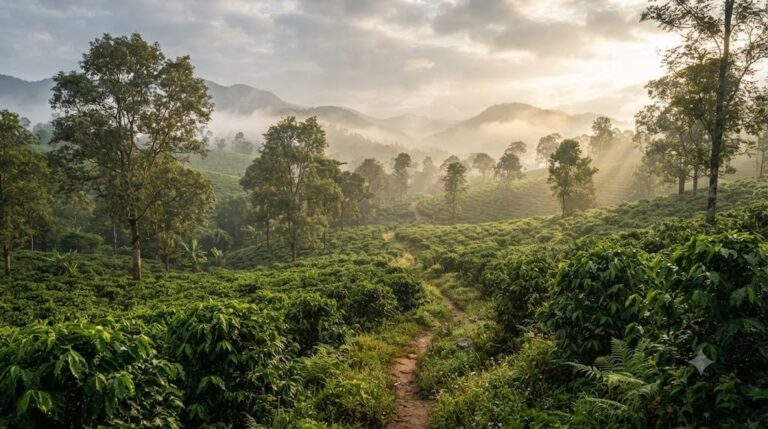
Perched high on the crestline of the central Western Ghats in Shimoga district, Agumbe stands as one of the world’s most ecologically vital tropical rainforest ecosystems. Revered as the ‘Cherrapunji of South India’ due to its astonishing annual rainfall exceeding seven thousand millimeters, Agumbe is the global research capital for the King Cobra (Ophiophagus hannah), a biodiversity paradise of bioluminescent fungi, endemic amphibians, and unbroken cloud forest canopies.
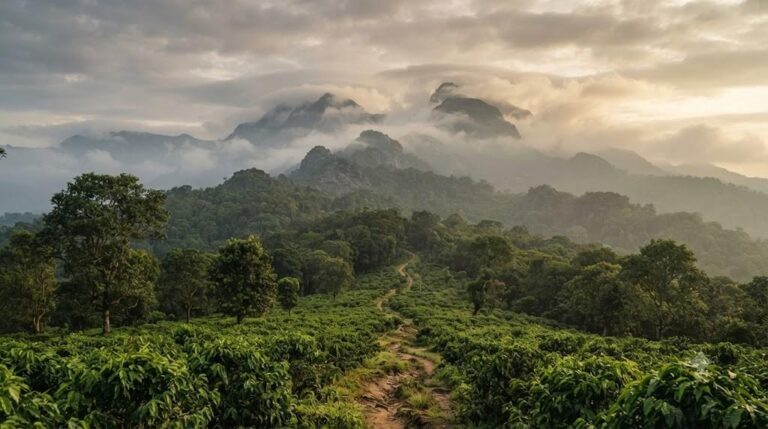
For herpetologists, tropical ecologists, naturalists, and wilderness explorers, the mist-draped hamlet of Agumbe represents a holy grail of tropical biodiversity. Situated at an elevation of six hundred and forty-three meters on the western escarpment of the Sahyadri mountain range, Agumbe looks directly out over the Arabian Sea coastal plains. It was this picturesque, rain-drenched village that provided the timeless setting for the television adaptation of R.K. Narayan’s immortal literary classic Malgudi Days. Beyond its cultural charm, Agumbe preserves one of the most intact tracts of low-elevation tropical wet evergreen dipterocarp rainforest remaining on the planet.
The Meteorology of the Monsoon: The Deluge of the Sahyadris
The defining meteorological force of Agumbe is the ferocious Southwest Monsoon. As moisture-laden clouds sweep eastward across the warm expanse of the Arabian Sea, they encounter the near-vertical wall of the Western Ghats. Forced to rise abruptly through orographic lifting, the air cools rapidly, condensing into immense cumulonimbus cloud systems that release catastrophic, relentless downpours over the crestline.
During the peak monsoon months of June, July, and August, Agumbe frequently records over seven thousand to eight thousand millimeters (over twenty-six feet) of rain. Days can turn into weeks without a single glimpse of sunlight. Mountain rivulets swell into raging torrents, tree barks are swathed in dripping emerald mosses, and the humidity remains locked at ninety-nine percent, creating an atmospheric greenhouse that nurtures unparalleled evolutionary specialization among flora and fauna.
The Tropical Wet Evergreen Forest Architecture
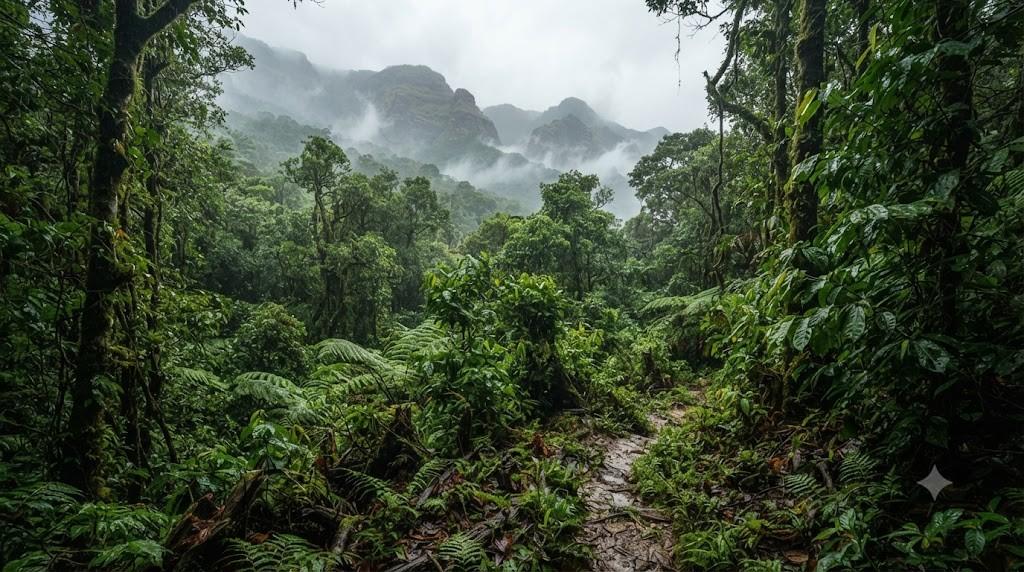
The rainforest of Agumbe is structurally complex, characterized by four distinct vertical strata that form a living green cathedral:
- The Emergent Layer (35 to 50+ meters): Towering hardwood giants, predominantly of the family Dipterocarpaceae—including Dipterocarpus indicus, Vateria indica (white dammar), and Calophyllum tomentosum—soar above the forest canopy, their massive buttressed roots stabilizing the thin, nutrient-poor rainforest soil against hydraulic erosion.
- The Continuous Canopy (20 to 30 meters): A dense, interlocking roof of branches covered with epiphytic orchids, ferns, and climbing aroids that captures virtually all available sunlight.
- The Understory and Shrub Layer (3 to 10 meters): A shadowy, perpetually damp realm dominated by wild cinnamon (Cinnamomum), wild nutmeg (Myristica), dwarf cane palms, and woody lianas that twist like massive python coils between trunks.
- The Forest Floor: A thick, spongy carpet of decomposing leaf litter inhabited by thousands of species of fungi, giant pill millipedes, land crabs, and blood-sucking terrestrial leeches (Haemadipsa) that thrive during the wet monsoon.
| Ecological Zone / Reserve | Altitude (Meters) | Forest Type | Flagship Species | Key Ecological Significance |
|---|---|---|---|---|
| Agumbe Rainforest Core | 643 m – 850 m | Tropical wet evergreen rainforest | King Cobra, Lion-tailed Macaque, Malabar Pit Viper | Global research site for king cobra telemetry and nesting |
| Someshwara Wildlife Sanctuary | 75 m – 870 m | Semi-evergreen to moist deciduous | Leopard, Gaur, Tiger, Great Hornbill | Crucial contiguous lowland-to-highland ecological corridor |
| Kudremukh Foothills Buffer | 500 m – 1,200 m | Shola montane forest & evergreen | Malabar Giant Squirrel, Slender Loris, Flying Squirrel | High-altitude cloud forest watershed protection |
| Barkana / Onake Abbi Gorges | 400 m – 700 m | Deep riverine rainforest ravines | Torrent frogs, Myristica swamp species, Hornbills | Massive river gorges feeding west-flowing Sita river |
| Kundadri Mountain Peak | 826 m | Evergreen crest with rocky monolithic summit | Endemic orchids, raptors, ancient 17th-century Jain basadi | Panoramic sunset view over Western Ghats canopy |
The Realm of the King Cobra: The Agumbe Rainforest Research Station
Agumbe is renowned worldwide as the undisputed capital of King Cobra (Ophiophagus hannah) ecology and conservation biology. The King Cobra—the world’s longest venomous snake, reaching lengths of up to five and a half meters—finds its ultimate ecological refuge within these dense, undisturbed evergreen valleys.
In 2005, legendary Indian herpetologist and conservationist Romulus Whitaker established the pioneering Agumbe Rainforest Research Station (ARRS). Situated inside a remote research enclave within the forest, ARRS spearheaded the world’s first comprehensive radio-telemetry study of wild King Cobras, fundamentally revolutionizing scientific understanding of this magnificent, misunderstood apex predator.
Fascinating King Cobra Biology and Nesting Behavior
The King Cobra exhibits behavioral complexities that are entirely unique among the world’s three thousand snake species:
- The Sole Nest-Building Serpent: The female King Cobra is the only snake on Earth that actively constructs an above-ground nest for her eggs. Utilizing the coils of her muscular body like a natural rake, the female gathers fallen bamboo and rainforest leaves into a substantial, two-tiered mound up to a meter high. The lower chamber contains twenty to forty eggs, insulated by the natural heat generated by the decomposing leaf litter, while the mother coils atop the upper chamber, fiercely guarding her brood without feeding for over eighty days until the eggs hatch.
- Obligate Ophiophagy (Snake-Eater): As its scientific name Ophiophagus denotes, the King Cobra feeds almost exclusively on other snakes—including venomous pit vipers, kraits, and non-venomous rat snakes—playing an indispensable ecological role in controlling reptile populations across the forest.
- Pioneering Radio-Telemetry Research: ARRS researchers surgically implanted miniaturized radio transmitters into wild King Cobras, tracking their movements through the dense canopy for years. The research revealed that King Cobras maintain vast home ranges exceeding thirty square kilometers, actively navigate human-altered agricultural landscapes without harming farmers, and demonstrate complex spatial memory and territorial navigation.
🦎 Herpetological Wonder: The Malabar Pit Viper
Among Agumbe’s rich reptile community, the Malabar Pit Viper (Craspedocephalus malabaricus) is celebrated for its extraordinary color polymorphism. Individuals of the exact same species can appear in vibrant lime green, rich mustard yellow, mottled brown, or deep orange-red, possessing heat-sensing facial pits between their eyes and nostrils that detect the thermal signatures of warm-blooded prey in total darkness.
The Wonders of the Night: Bioluminescence and Amphibian Symphonies
When the sun sets over the Sahyadris, the rainforest of Agumbe awakens into a mesmerizing nocturnal wonderland. For naturalists equipped with headlamps and UV torches, night walks through the forest reveal biological phenomena that seem pulled from a fantasy realm.
Bioluminescent Fungi (The Glowing Forest): During the peak monsoon months, decaying logs and forest debris glow with an ethereal, neon-green light. This phenomenon—caused by bioluminescent fungi of the genus Mycena—occurs through a chemical reaction between the enzyme luciferase and oxygen, illuminating the dark forest floor in a soft, surreal emerald radiance designed to attract nocturnal spore-dispersing insects.
Amphibian Diversity: Agumbe is home to an extraordinary concentration of endemic frogs and toads, many discovered by science only within the past two decades. As darkness falls, the forest fills with an acoustic symphony of thousands of mating calls:
- The Malabar Gliding Frog (Rhacophorus malabarensis): A radiant green tree frog with bright red webbing between its long toes. By leaping from high branches and spreading its webbed feet, the frog can glide aerodynamically for over ten meters between trees. Females create large foam nests suspended over forest pools, into which they deposit their eggs.
- The Torrent Frogs (Micrixalus): Known popularly as ‘dancing frogs’, these small amphibians inhabit rushing, noisy mountain streams. Because their vocal calls are drowned out by roaring water, males communicate visually by kicking their back legs outward and waving their webbed white toes in an elaborate, rhythmic territorial display known as ‘foot-flagging’.
- Kottigehar Dancing Frog and Caecilians: Rare, subterranean limbless amphibians that resemble giant earthworms, burrowing through the damp humus and feeding on soil invertebrates.
| Endemic Species | Scientific Classification | Unique Behavioral Adaptation | Habitat Niche | Conservation Status |
|---|---|---|---|---|
| King Cobra | Reptilia (Ophiophagus hannah) | Nest building, specialized snake diet, radio-tracked | Dense evergreen ravines & bamboo | Vulnerable (IUCN) |
| Malabar Gliding Frog | Amphibia (Rhacophorus malabarensis) | Webbed aerodynamic gliding, aerial foam nests | High rainforest tree canopies | Least Concern (Endemic) |
| Dancing Frog | Amphibia (Micrixalus species) | Visual foot-flagging territorial communication | Torrential rushing mountain streams | Endangered (Localized) |
| Lion-Tailed Macaque | Mammalia (Macaca silenus) | Arboreal fruit specialist, silver mane | High evergreen dipterocarp canopy | Endangered |
| Bioluminescent Mycena | Fungi (Mycena chlorophos) | Luciferase enzymatic green glowing emission | Decaying rainforest logs & wet bark | Sensitive to habitat loss |
Dramatic Cascades: Barkana, Onake Abbi, and Jogi Gundi
The staggering precipitation of Agumbe feeds numerous deep river gorges that plunge over the Western Ghats escarpment, creating some of the most dramatic, inaccessible waterfalls in South India:
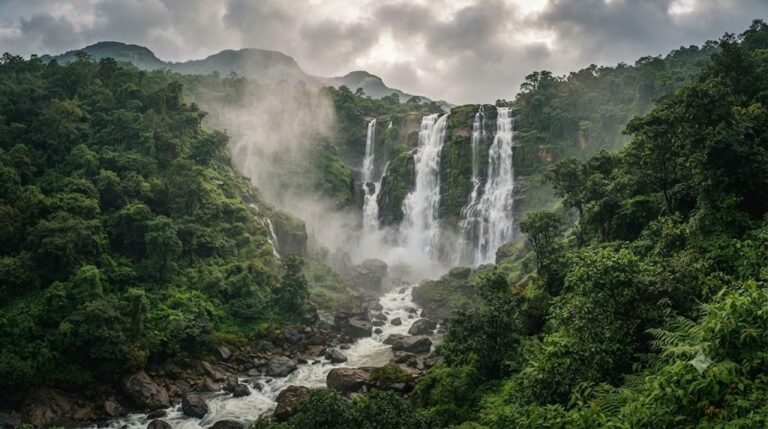
Barkana Falls: Ranking among India’s ten highest waterfalls, the Barkana Falls plunges over two hundred and fifty-nine meters (eight hundred and fifty feet) down a near-vertical amphitheater of sheer granite in the Someshwara Wildlife Sanctuary. Formed by the Sita River, the waterfall creates a permanent mist cloud that rises from the abyss, nourishing rare ferns and epiphytic mosses along the gorge walls.
Onake Abbi Falls: Located four kilometers from Agumbe village, this spectacular cascade drops over one hundred and ten meters into a pristine forest bowl. The waterfall derives its name from the Kannada word ‘Onake’ (a long wooden pestle traditionally used for pounding grain), describing the single, unbroken column of falling water that strikes the rocks below.
Jogi Gundi Falls: A secluded forest pool where a crystal-clear mountain stream flows through natural rock caverns before pouring over a smooth granite ledge. According to local lore, a revered ascetic (Jogi) meditated inside the subterranean caves behind the falling water for decades, imparting a serene, meditative aura to the hidden cascade.
🏛️ Heritage Highlight: The 17th-Century Jain Basadi of Kundadri
Rising sixteen kilometers from Agumbe, the monolithic rock hill of Kundadri reaches eight hundred and twenty-six meters above sea level. Crowned by a charming seventeenth-century stone Jain temple dedicated to Parshvanatha, the peak was the ancient meditation site of Jain Acharya Kundakunda. Two ancient lotus-filled rock ponds beside the temple reflect sweeping views of cloud-covered valleys.
Eco-Ethics, Leech Protection, and Rainforest Exploration Guidelines
Venturing into the Agumbe rainforest requires specialized preparation, immense patience, and profound environmental discipline. The rainforest is a wild, untamed ecosystem that demands respect:
- Preparation for Leeches (The Rainforest Reality): During the wet months, terrestrial leeches (Jigane) are ubiquitous on the forest floor. Hikers should wear specialized high-topped canvas leech socks, tuck trousers securely into socks, and apply traditional natural deterrents such as tobacco powder, neem oil, or salt water to footwear. Remember that leeches are harmless parasites that do not transmit human diseases; stay calm and gently remove them using flat fingernails rather than ripping them off.
- Rainproof Gear and Electronics: The moisture in Agumbe penetrates standard equipment. Pack professional-grade dry bags, silicone desiccants for camera lenses, and heavy-duty waterproof rain ponchos. Avoid taking sensitive electronic devices into heavy downpours without dedicated waterproof housing.
- Strict Ethical Herpetology Protocols: Never handle wild venomous snakes or disturb nesting King Cobras. Flash photography must be kept to a minimum on sensitive amphibians and nocturnal geckos. Always explore forest trails in the company of certified local naturalists who understand snake behavior and emergency protocols.
- Respect Village Life and Eco-Tourism Limits: Agumbe is a peaceful agricultural community, not a commercial hill resort. Loud music, open-air alcohol consumption, and plastic littering are strictly prohibited by local village councils and the Karnataka Forest Department. Support local heritage homestays like the famous Kasturi Akka’s House (Doddamane), which hosted the cast of Malgudi Days and continues to serve authentic Satvik Malnad cuisine to travelers with legendary warmth.
In conclusion, Agumbe is far more than a rain-swept destination; it is an irreplaceable living temple of planetary ecology. Standing on the crest of the Sahyadri mountains as thunder rumbles in the distance, watching the emerald canopy steam under a brief glimpse of sun, and knowing that the King Cobra reigns supreme in the shadowed valleys below is an experience that humbles the human spirit and reaffirms our sacred duty to protect the wild wonders of the Earth.
Myristica Swamps: The Ancient Jurassic Wetlands of Agumbe
Tucked within the deep riverine valleys of the Agumbe rainforest lies one of the rarest, most endangered freshwater wetland ecosystems on Earth: the Myristica Swamps. Dominated by primitive wild nutmeg trees belonging to the family Myristicaceae—such as Gymnacranthera canarica and Myristica fatua—these prehistoric wetlands date back millions of years to the Jurassic era.
To survive in perpetually waterlogged, anaerobic soil conditions, Myristica trees have evolved astonishing physical adaptations: massive stilt roots that arch out from the lower trunk to anchor the tree in deep mud, and specialized aerial breathing roots called pneumatophores (knee roots) that protrude upward through the water surface like twisted wooden fingers to absorb oxygen. These primeval swamps serve as critical perennial water sponges and provide exclusive breeding grounds for rare amphibians, torrent frogs, and freshwater crabs found nowhere else on the planet.
The Cultural Legacy of Malgudi Days in Agumbe
For millions of television viewers across India, Agumbe is forever immortalized as the visual embodiment of ‘Malgudi’—the fictional South Indian town created by literary legend R.K. Narayan. In the late 1980s, acclaimed filmmaker Shankar Nag chose Agumbe as the principal filming location for the beloved television series Malgudi Days.
The iconic hundred-and-twenty-year-old heritage tile-roofed mansion known as Doddamane (The Big House) served as the primary set for young Swami and his friends. Preserved in its original wooden architectural glory with massive carved pillars, red-oxide floors, and open inner courtyards, the house continues to welcome traveling writers, artists, and naturalists, maintaining a warm, nostalgic connection between classical Indian literature and the pristine beauty of the Sahyadris.
🌿 Herpetology Safety Tip: Coexisting With Reptiles
When exploring Agumbe’s trails, always maintain a respectful distance from wild reptiles. King Cobras and pit vipers are inherently shy, non-aggressive creatures that strike only when cornered, stepped on, or harassed. By watching your step, using walking sticks to create ground vibrations, and wearing protective footwear, you ensure total safety for both yourself and the wildlife.