🌊 Liquid Thunder: The Cascading Wonders of the Sahyadris
Carved by thunderous monsoon torrents plunging off the sheer granite escarpment of the Western Ghats and Deccan Plateau, Karnataka is universally celebrated as the waterfall capital of South Asia. From the colossal four-stream chasm of Jog Falls on the Sharavathi River to the roaring twin island cataracts of Shivanasamudra on the Cauvery, the state’s cascades represent a breathtaking spectacle of raw hydrological power, geological drama, and renewable energy history.
Waterfalls are the dramatic lifeblood of Karnataka’s landscape. Born in the mist-shrouded rainforests of the Sahyadri mountains where annual precipitation frequently surpasses four thousand millimeters, hundreds of westward and eastward-flowing rivers tumble over steep volcanic basalt and granite fault-lines. For landscape photographers, adventure travelers, and naturalists, embarking on a waterfall circuit across Karnataka offers an intimate exploration of South India’s most pristine river gorges, dense evergreen forests, and historic hydroelectric engineering achievements.
Jog Falls: The Colossus of the Sharavathi River
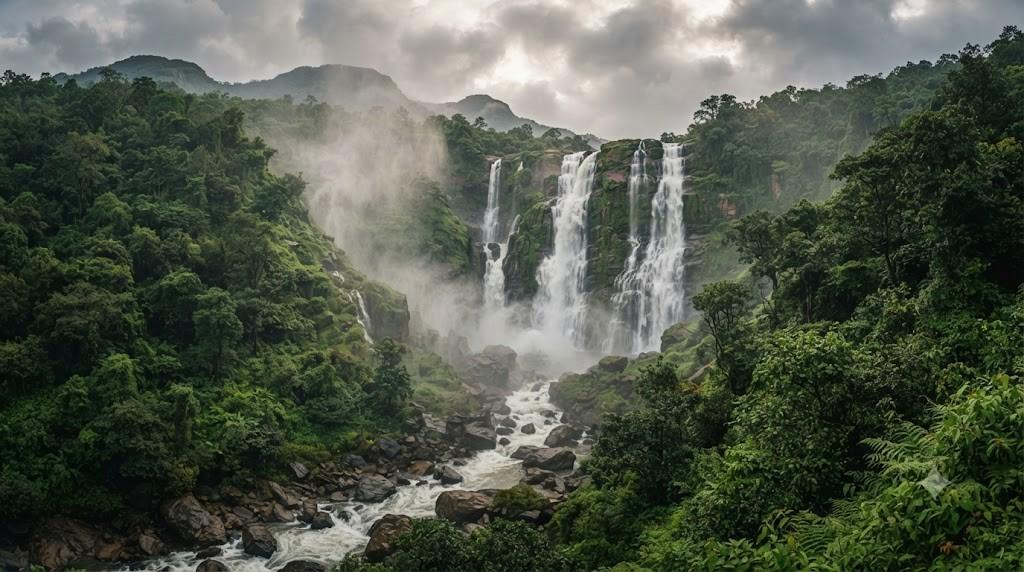
Ranking as one of India’s most famous and awe-inspiring natural spectacles, Jog Falls (also known as Gerosoppa Falls) is situated in the Shimoga district near Sagara. Here, the westward-flowing Sharavathi River—having meandered through dense Malnad forests—abruptly encounters a monumental vertical chasm, plunging two hundred and fifty-three meters (eight hundred and thirty feet) into a sheer, mist-filled rocky abyss.
What makes Jog Falls globally unique among the world’s great waterfalls is its dramatic fragmentation into four distinct named cascades, each possessing its own characteristic personality, trajectory, and sonic signature:
- Raja (The King): The grandest and most powerful stream. An unbroken, thunderous column of water that charges forward with immense velocity, plummeting straight down the center of the chasm without touching the vertical rock face until it crashes into the deep pool below.
- Roarer: Emerging from a deep, tortuous rock fissure to the left of the Raja, this turbulent stream rushes out at an angle through a natural rock funnel, emitting a deafening, continuous sonic roar that reverberates across the entire canyon.
- Rocket: Flowing adjacent to the Roarer, the Rocket shoots through a series of narrow rock constrictions at extreme velocity, bursting outward into multiple high-speed jets and spray plumes that resemble ascending fireworks.
- Rani (The Queen): The most graceful and poetic of the four. Flowing over the far right edge of the cliff, the Rani dances down the rock face in a delicate, swirling sheet of white foam and mist, catching the morning sunlight to create vibrant double rainbows across the gorge.
| Waterfall Name | District / Location | Parent River | Drop Height (Meters) | Distinctive Hydrological Feature |
|---|---|---|---|---|
| Jog Falls | Shimoga / Sagara | Sharavathi River | 253 m (830 ft) | Four distinct cascades (Raja, Roarer, Rocket, Rani) in a massive chasm |
| Shivanasamudra (Gaganachukki) | Mandya / Malavalli | Cauvery River | 98 m (320 ft) | Segmented twin cataracts around rocky island, Asia’s 1st hydro plant (1902) |
| Shivanasamudra (Bharachukki) | Chamarajanagar / Kollegal | Cauvery River | 98 m (320 ft) | Broad, curving horseshoe amphitheater with powerful multiple spray chutes |
| Abbey Falls | Kodagu / Madikeri | Cauvery Tributary | 21 m (70 ft) | Nestled in dense shade-grown coffee & spice estate, hanging suspension bridge |
| Magod Falls | Uttara Kannada / Yellapur | Bedti River | 198 m (650 ft) | Two-tiered cascade plunging into deep, forested granite river canyon |
| Unchalli Falls (Lushington) | Uttara Kannada / Siddapur | Aghanashini River | 116 m (380 ft) | Ear-splitting cascade plunging through dense, untouched rainforest gorge |
The Hydroelectric Legacy: The Linganamakki Reservoir and Mahatma Gandhi Power Station
Beyond its scenic grandeur, Jog Falls occupies a hallowed position in the industrial history of South Asia. Upstream from the falls lies the massive Linganamakki Dam, constructed across the Sharavathi River in 1964, creating an expansive freshwater reservoir that feeds the Mahatma Gandhi Hydroelectric Project.
Commissioned initially in 1948 under the visionary direction of Sir M. Visvesvaraya, this hydroelectric facility was one of India’s earliest large-scale renewable energy installations, powering early industries across southern Karnataka. Because river flow is heavily regulated by the Linganamakki Dam, Jog Falls presents two distinct seasonal faces: during the dry winter and summer months, the falls are reduced to slender trickles against the dark cliff; however, during the peak monsoon months when the dam gates are opened, the four streams unite into a colossal, deafening wall of brown foam that fills the entire valley with impenetrable spray.
👟 Viewing Logistics: The 1,400-Step Descent
Visitors to Jog Falls can view the spectacle from panoramic viewpoints near the British-era inspection bungalow or descend a steep flight of approximately one thousand four hundred concrete steps down to the base of the gorge. The descent offers an unforgettable sensory experience of rising mist and acoustic thunder, though the strenuous return climb requires good cardiovascular fitness.
Shivanasamudra Falls: The Twin Cataracts of the Cauvery Island
Situated sixty-five kilometers east of Mysuru in the southern Deccan plateau, the sacred Cauvery River divides into two wide branches encircling the rocky island of Shivanasamudra. As these two river branches reach the edge of a massive granite plateau, they plunge down a sheer ninety-eight-meter precipice, creating two world-renowned twin waterfalls separated by several kilometers:
Gaganachukki: The Vertical Roar
The western branch of the river forms Gaganachukki (translating to ‘The Sky Drop’). Here, the river cascades over a jagged, steep rock face in two massive segmented torrents that converge into a raging, boiling pool surrounded by sheer vertical cliffs. A historic colonial watchtower perched on the western ridge offers safe, panoramic views of the cataract, where the spray rises like steam high into the blue sky.
Bharachukki: The Horseshoe Amphitheater
A few kilometers to the east lies the broader and visually breathtaking Bharachukki Falls. Unlike the narrow, compressed torrent of Gaganachukki, Bharachukki spills over a wide, sweeping curved amphitheater of dark granite, creating dozens of parallel chutes of foaming white water. During the post-monsoon months, coracle boats (traditional circular wicker boats coated in waterproof bitumen) navigate the calm outer edges of the spray pool, allowing adventurers to experience the mist clouds up close.
⚡ Historical Engineering Milestone: Asia’s First Hydroelectric Station (1902)
In 1902, the visionary Dewan of Mysore, K. Seshadri Iyer, and Sir M. Visvesvaraya commissioned the historic Shivanasamudra Hydroelectric Plant at the base of Gaganachukki Falls. It was the very first operational commercial hydroelectric installation in all of Asia, generating electric power that was transmitted over one hundred and forty kilometers through high-voltage cables to illuminate the gold mines of Kolar (KGF), a feat celebrated globally at the turn of the twentieth century.
The Hidden Jewels of Uttara Kannada: Magod, Sathodi, and Unchalli
While Jog and Shivanasamudra are celebrated on mass tourist itineraries, the deep, untouched rainforests of Uttara Kannada district harbor some of the most dramatic, remote, and ecologically pristine waterfall gorges in the country:
Magod Falls: Located nineteen kilometers from Yellapur, the pristine Bedti River plunges nearly two hundred meters in two distinct stages into a colossal, densely forested granite canyon. Surrounded by untouched evergreen jungle that shelters leopards, king cobras, and black panthers, the roar of Magod echoes across deep ravines where clouds of morning mist hover until midday.
Sathodi Falls: Formed by the union of several forest streams tumbling into the Kodasalli Reservoir, Sathodi is often hailed by landscape photographers as the most picturesque cascade in Karnataka. Water falls thirty-two meters over a rectangular rock ledge into a calm, emerald-green natural swimming pool framed by sheer sandstone cliffs dripping with wild maidenhair ferns.
Unchalli Falls (Lushington Falls): Hidden deep within the wilderness of Siddapur taluk, the Aghanashini River—flowing wild and un-dammed from the Sahyadris—drops over one hundred and sixteen meters into a deafening chasm. Discovered to the Western world in 1845 by British District Collector J.D. Lushington, the waterfall is known locally as Keppa Joga (The Deafening Fall) because the acoustic roar generated by the cascade plunging through the narrow rock funnel literally drowns out human speech for hundreds of meters around.
| Waterfall | Best Visiting Months | Road Access & Difficulty | Nearby Town | Safety Rating & Swimming Policy |
|---|---|---|---|---|
| Jog Falls | July to December | Excellent paved highway, moderate steps | Sagara / Shimoga | High safety barriers, swimming strictly banned |
| Shivanasamudra | August to January | Smooth state highway, easy viewing decks | Malavalli / Mandya | Viewing decks safe, coracles licensed with lifejackets |
| Magod Falls | October to February | Narrow winding forest road, short walk | Yellapur | Fenced viewpoints, canyon swimming prohibited |
| Sathodi Falls | November to March | Forest dirt track, moderate rocky walk | Yellapur | Pool swimming allowed with caution during dry months |
| Unchalli Falls | September to January | Forest road, 1 km downhill trek | Siddapur | Viewing platform secure, canyon floor strictly off-limits |
Southern Cascades: Abbey, Iruppu, and the Western Ghats Slopes
The highland district of Kodagu (Coorg) adds its own romantic, mist-filled cascades to Karnataka’s waterfall map:
Abbey Falls: Tucked within a private coffee and cardamom plantation just eight kilometers from Madikeri, Abbey Falls drops twenty-one meters over boulders into a swirling river gorge. The waterfall is framed by hanging lianas, wild ferns, and towering silver oaks. A pedestrian suspension bridge built directly across the gorge provides an exhilarating vantage point where cool mist sprays visitors’ faces.
Iruppu Falls: Located along the southern boundary of Coorg bordering Kerala, Iruppu Falls plunges sixty meters down the Brahmagiri range. Revered in the Ramayana as the sacred stream created by Lakshmana, the falls draw pilgrims who bathe in its cold waters to purify sins before visiting the nearby ancient Rameshwara Temple.
Waterfall Safety Protocols and Ecological Preservation
While Karnataka’s waterfalls are mesmerizingly beautiful, their raw hydrological power demands extreme caution, physical respect, and environmental discipline from visitors:
- Respect Flash Flood Warnings: Western Ghats rivers are subject to rapid, unpredictable flash floods triggered by sudden cloudbursts in upstream mountain catchments. Never cross safety barriers or wade into riverbeds when skies are overcast upstream.
- Slippery Basalt Algae: The volcanic rocks surrounding tropical waterfalls are coated in invisible films of microscopic wet algae. These surfaces are notoriously slick—far more dangerous than ice. Wear specialized non-slip hiking footwear with Vibram-grade rubber lugs and avoid stepping on dark wet rocks.
- Strict Alcohol and Littering Bans: The vast majority of tragic waterfall accidents across South India involve intoxicated visitors venturing beyond safety railings. Karnataka Forest Department strictly enforces zero-alcohol and zero-littering rules across all waterfall reserves, imposing heavy fines on violators.
- Preserve Fragile Riparian Habitats: River gorges are critical breeding grounds for rare endemic amphibians, freshwater otters, and kingfishers. Never discard plastic bottles, soap detergents, or snack packaging into pristine river streams.
In conclusion, Karnataka’s waterfalls stand as timeless monuments of natural architecture. From the celestial thunder of Jog Falls to the historic twin cataracts of Shivanasamudra and the secret emerald gorges of Uttara Kannada, these falling waters sing the ancient, untamed song of the Sahyadri mountains—a symphony of power, beauty, and life that rejuvenates the spirit of all who stand before them.
Geological Fault-Lines and the Formation of Sahyadri Waterfalls
The staggering abundance of colossal waterfalls across Karnataka is the direct result of dynamic plate tectonics and ancient geological fault-lines. When the Indian tectonic plate detached from the Gondwana supercontinent approximately sixty-five million years ago and collided with the Eurasian landmass, immense volcanic basalt eruptions formed the Deccan Traps, tilting the peninsular plateau gently eastward.
The western edge of this tilted plateau terminates abruptly along the Western Ghats escarpment, creating a sheer geological cliff face rising between six hundred and one thousand eight hundred meters above the Arabian Sea coastal plain. As high-volume rivers born in high-rainfall mountain catchments flow toward either the western sea or eastern plains, they encounter these vertical basalt and granite fault scarps, dropping precipitously down sheer cliffs to create the majestic cataracts seen at Jog, Magod, Barkana, and Unchalli.
The Historical Evolution of Hydroelectric Generation in Karnataka
Karnataka’s waterfalls have played a pioneering role in the industrial modernization of South Asia. Following the historic commissioning of the Shivanasamudra hydroelectric station in 1902—which illuminated the Kolar Gold Fields over a hundred kilometers away—the state continued to lead the nation in clean, renewable hydroelectric engineering.
The Sharavathi Hydroelectric Project at Jog Falls, developed in successive phases throughout the twentieth century, remains one of the largest underground power stations in India, capable of generating over one thousand megawatts of clean electricity. Utilizing deep subterranean tunnels carved through solid granite, water is diverted from the Linganamakki reservoir into high-pressure penstocks, spinning massive turbines nestled hundreds of feet inside the mountain without permanently disfiguring the natural landscape above, showcasing a pioneering balance between industrial progress and environmental conservation.
📷 Landscape Photography Masterclass: Capturing Waterfalls
Photographing Karnataka’s waterfalls during the monsoon requires specialized technical preparation. To capture the ethereal, silky smooth motion of falling water, use a neutral density (ND) filter with an exposure time between one-quarter and two seconds, mounted on a sturdy tripod. Always keep microfiber lens cloths handy to wipe off drifting spray mist between exposures.